 In an unexpected boost for Utah tourism, a story of outdoor adventure has captured the world’s imagination — a “goat-man” has been discovered frolicking among the state’s herds of wild goats.
Utah’s Department of Wildlife Resources, naturally, is concerned that the man dressed in a crude goat costume might get shot by hunters or, more likely, attacked by one of the bonafide mountain goats who are not know for their sense of whimsy.
“They may get agitated. They’re territorial. They are, after all, wild animals,” DNR’s Phil Douglass told the AP. “This person puts on a goat suit, he changes the game.”
It seems reasonable that even the most laid-back mountain goat could become “agitated” by a dude in fuzzy costume sneaking up from behind.
Still, the DWR doesn’t want to impinge on the goat-man’s freedom of expression, Douglass said.
“People do some pretty out-there things in the name of enjoying wildlife. But I’ve never had a report like this. There’s a saying we have among biologists – You don’t go far enough, you don’t get the data. You go too far, you don’t go home. The same is true with some wildlife enthusiasts.”
Glen Warchol writes about arts, culture and politics. You can also read his work at SaltLakeMagazine.com.

For most people, the idea of a bluegrass show featuring comedian and actor (not to mention novelist, playwright, memoirist and noted art collector) Steve Martin might seem incongruous to the famous man they THINK they know.
But even the most casual of fans who might remember Martin from his ’70s “wild and crazy guy” phase will recall that a banjo has been present as long as they remember the existence of Steve Martin. Pickin’ and grinnin’ have gone hand in hand for the SoCal native from the very beginning, but it’s only in the last few years that Martin turned his attention to recording and playing live music in a serious way.
And make no mistake–Martin’s dedication to bluegrass IS serious. He’s now made two albums with North Carolina’s Steep Canyon Rangers, a traditional bluegrass crew that was already making noise in acoustic music circles well before the Hollywood Renaissance Man started trading licks with them. The International Bluegrass Music Association named Martin and the Steep Canyon boys as the group’s “Entertainers of the Year” for 2011–a salutation that Martin made into a between-song joke.
“If you’re not enjoying the show so far,” Martin announced roughly mid-show, while noting the IBMA award, “you’re wrong.”
One-liners between songs from Martin’s two bluegrass albums, 2009’s The Crow: New Songs for the 5-String Banjo and 2011’s Rare Bird Alert, were the rule for the night. Among the highlights from Martin’s banter:
– “A lot of people say to me, ‘Steve, why a music career? Why now?’ And I say, ‘Guys! You’re in my band!'”
– “There is a downside to touring without a drummer. No pot.”
– ” Tonight I’m doing two of my favorite things: Comedy, and charging people to hear music.”

Steve Martin and the Steep Canyon Rangers performing Thursday night at Red Butte Garden.
While the jokes were certainly some of the highlights of the show, the chops of the players in the Steep Canyon Rangers, and Martin himself, were nothing to sneer at. Martin was a generous bandleader, giving each of the Rangers a chance for solo spots over the course of the night. At one point, Martin left the stage completely so the Rangers could strut their collective stuff, only popping up to hype them to the audience before leaving the spotlight again.
“Daddy Played the Banjo” was an early highlight, as was a new song I believe was called “Love Has Come for You.” Martin mixed his introductions of the Rangers with a steady diet of good-hearted mocking before launching into a strong series of songs including “The Crow,” “Jubilation Day” and the a cappella take of “Atheists Don’t Have No Songs.”
Martin delivered a little banjo knowledge about the three-finger vs. clawhammer playing styles before performing “The Great Rememberer (for Nancy),” and educated the crowd about murder ballads before “Pretty Little One.”
Throughout the show, the charm of Martin and his fellow musicians on stage at the sold-out gig came through loud and clear, via Martin’s memorable asides and the rapid-fire delivery of the fine bluegrass band joining him. This summer’s show certainly lived up to the quality of Martin’s last visit to Red Butte Garden. Here’s hoping the Renaissance Man comes back next time he hits the road.

When I first visited the Central Utah Art Center in Ephraim, I had one of those, “Wow, sometimes Utah can be a pretty cool place.” moments.
CUAC, run by a group of young artists and curators, has been exhibiting international contemporary art–including Julian Opie, Kerry James Marshall, Jack Smith, Bek Stupak, Xaviera Simmons, Andrea Galvani–120 miles from Salt Lake City in the hinterlands.
Even more amazing, the edgy art, installed in a restored historic building on Main Street, seemed to have been embraced by the local community.

To link the gallery and Ephraim to the Wasatch Front, innovative supporters of CUAC (pronounced “quack”) instituted a monthly Art Bus, complete with a rolling video art gallery and beer, to bring art lovers from Salt Lake City and Provo to Ephraim for openings.
CUAC estimates it brought Ephraim 4,000 visitors annually adding $200,000 to its economy. “That’s a really significant impact,” says Director, artist and curator Adam Bateman, “comparable to the Scandanavian Days Celebration [Ephraim’s equivalent of Mardi Gras].”
CUAC also exhibited of local artists and taught art to elementary students.
This story of a rural community in a symbiotic relationship with a cutting-edge art gallery was so cool, it brought tears to my eyes.
What a chump I was. It was only a matter of time before Utah’s forces of unelightenment got wind of CUAC’s forward-leaning programs that attracted national attention, including a Andy Warhol Foundation grant.

CUAC will soon be thrown out on its ear. This cultural and economic catastrophe for San Pete County apparently is the result a recent show that featured exposed boobs.
CUAC’s board is calling the city’s decision blatant censorship. The city council, along with the mayor and city manager judged CUAC’s exhibits to be “not San Pete appropriate.”
“That the surprise eviction comes at a time when CUAC is exhibiting three photographs which depict women’s breasts in an exhibition that explores racially-based civil injustices is no coincidence,” says Bateman.
It’s interesting to note that Jeff Lambson, curator of contemporary art at the Brigham Young University Museum of Art, is on CUAC’s board and Mark Magleby, director of BYUMOA, has lauded CUAC a key player in a recent increase in appreciation of contemporary art in Utah.
Bateman, who is a county native, says he doubts the eviction is supported by the broader community. “When they said the art wasn’t ‘San Pete appropriate,’ I said, ‘I’m from Sanpete County.’ This community has greatly surpassed anything that an art venue expects of its audience. The San Pete audience has been receptive and willing to learn and has been appreciative of what we are doing.”
CUAC yet to decide its next move. Options include finding a new space in Ephraim or abandoning the county entirely. A move to the Wasatch Front would bring CUAC a larger audience, but Bateman says CUAC would miss its supportive Sanpete audience.
“The plan is to let the dust settle and get some funding on track and listen to some proposals–then we’ll know a lot more,” Bateman says.
Examples of art exhibited at CUAC—
Top: Ben Stupak, Video still from Flaming Creatures (Blind Remake)
Above right: Julian Opie, “The Ortega Family”

In The Leonardo’s newest exhibit, “Water: Nature’s Driving Force,” Australian photographer Paul Blackmore documents the universal role of water in ecology, landscape, economics, recreation and religion and spirituality.
With 80 percent of the nation suffering a drought, the Leo’s timing couldn’t be better.
As desert dwellers, Utahns will feel a natural affinity for Blackmore’s subject and the people he presents, ranging from religious pilgrims in India to public bathers in Japan. To bring the exhibit home, Blackmore took a whirlwind trip through Utah to add a series of shots of local water sites, including Glen Canyon Dam and a mineral-encrusted bathtub at a remote hot spring in Central Utah. (The photo above is of swimmers at Utah’s major water feature, the Great Salt Lake.)
Explains Blackmore, “I wanted people to look at the local pictures and say, ‘This is my life!’ and understand their connection with water is the same as people everywhere.”
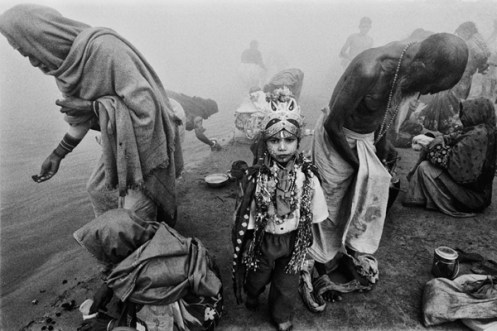
A child, dressed as a deity, walks through the pilgrims on the bank of the Ganges.
In the Leo’s mission of presenting art, science and technology as a seamless whole, the exhibit includes instructional installations that give museum visitors an idea of the challenge of providing clean water to meet the world’s ever-growing need.
In a nook at the photo exhibit, Alexander Johnstone, The Leo’s exhibits and programs manager, has filled 293 gallon bottles with water to illustrate how much water the average Utah resident uses daily to drink, cook, wash their cars, sprinkle their lawns and chase their whiskey.
If that sounds like a lot, it is. Utah is the second driest state (right now, three-quarters of Utah is suffering extreme or severe drought), but has one of the highest water usages in the country. A person in a developing nation ekes by on five to eight gallons a day.
“We didn’t want to depress people,” says Johnston, “but we wanted them to be aware.”
The Leonardo, 209 E. 500 South, Salt Lake City, 801-531-9800
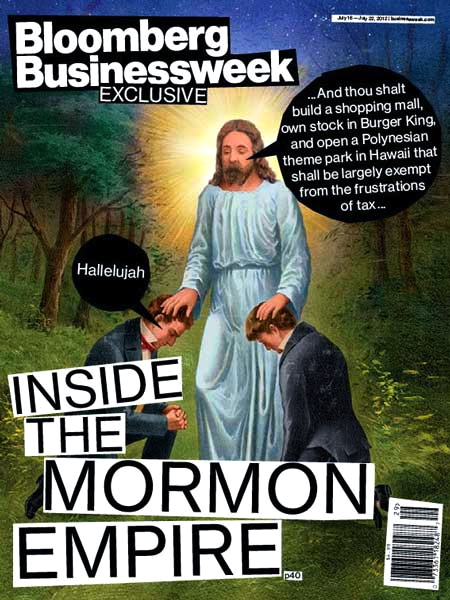
As Mitt Romney and Barack Obama, aided by their allies, continue to slug it out, national columnists and reporters are experiencing the agonies of covering the Mormon church.
Utah news media has had to deal with the sensitivities in reporting on the Church of Jesus Christ Latter-day Saints and its powerful members since the show rolled into the Salt Lake Valley (165 years ago this month!). Unfortunately, Utah media still hasn’t gotten very good at it.
Traditionally, a Utah reporter and editor/news director go through the following news selection process:
Step 1—Wow! We’ve stumbled onto a barn-burner of a story about (fill in the blank: Olympics, Main Street Plaza, City Creek Center, liquor laws, multi-million-dollar real estate scam, corruption at the Legislature, open records, trysts in hot tubs, potholes)!
Step 2—Oh-s**t! Reporter turns up the first Mormon connection. (Note: I’m not saying Mormons are any more dishonest as any other group just that they are as dishonest as any other group. And in a population that is at least two-thirds active Mormon, including most of the Legislature, the executive branch, school boards and the DABC—a even little digging into a story usually turns up an LDS luminary or lay clergyman.)
Step 3—Discussion begins: “If we aggressively report and write this story with its unfortunate Mormon connections, how long before our bosses get complaints that we’re “Mormon persecutors?” (about 43.5 seconds).
Step 4— Self censorship rears its hideous head.
Suddenly loose-cannon reporter (who is often a Mormon): “If we don’t go after this story like a pit bulls on crack—we betray our sacred watchdog role as a journalists.”
Sacredly objective editor: “Whoa, kid, let’s make sure our ducks are in a row and our motives are pure before I take the heat we proceed.”
Step 6 — Story runs in vicinity of obits. The developer/legislator/official LDS mouthpiece calls the editor/publisher/station owner to express “sadness and disappointment” in reporter’s motives.
The Deseret News and KSL, of course, skip this agonizing process and simply produce another series on drunken driving.
——-
On the national scene, the latest hapless victims being called anti-Mormon bigots are Andrew Sullivan at The Daily Beast and the editors at Bloomberg Business Week. BBW inexplicably gave Mormons an easy opening to attack an otherwise solid story on LDS Church finances by attaching a gratuitously tasteless cover image, shown above.
Sullivan, a Roman Catholic, has been arguing that Mitt Romney’s religion has “cultish qualities” and that is a subject that journalists need to explore in a presidential candidate:
Why cannot non-Mormons come and go in Mormon Temples as they can in Cathedrals and mosques and synagogues? Why is it so hard for some to leave the LDS Church without social ostracism and peer pressure? How much money would taxpayers be automatically giving the LDS church by paying the president his salary? How much control does the LDS hierarchy have over its members? Why is missionary work compulsory? Why were Ann Romney’s non-Mormon parents barred from attending her own Temple sealing?
Hoo-boy, Andy, you’ve saddened and disappointed the wrong people and can expect a freight train of passive-aggressive pain headed your way. The first shot from Mormondom came in the Washington Post:
No one believes Sullivan’s own Catholic Church—a global faith that has inspired some of the world’s greatest art, thought, and philanthropy — is a cult. But using Sullivan’s tactics, it isn’t hard to cast it in a dark, suspicious light.
Sullivan, whom any Utah reporter would have warned away from invoking the loaded C-word, responds to the first round of attacks here.
I am not going to be intimidated by accusations of “prejudice” into not exploring aspects of Mormon doctrine and practice when debating a presidential candidate whose entire identity has been forged by the LDS church and is one of the most prominent former church officials ever to run for president. This is a legitimate question about the identity and character and beliefs of a man running for the highest office in the land.
This is going to get ugly. (But generate lots of page views.)
The American Legislative Exchange Council convention being held In Utah this week is best viewed as a family reunion with all the usual shameful secrets. After all, a vast number of Utah GOP lawmakers have been entertained, honored, lavishly fed and have generally snuggled up with ALEC and its big-industry patrons for years.
ALEC pretends to be a conservative alternative to the National Conference of State Legislatures that trains lawmakers, right and left, on issues and effective government. But instead of policy experts, industry lobbyists tutor ALEC’s legislative members. If you love your capitalism unchained, it doesn’t get any better.
Even the left has to admit ALEC’s stealth approach is brilliant. Instead of industries sending lobbyists to each state’s legislatures—ALEC brings lawmakers to its gatherings, where they work and socialize with member industries and special interests, including the American Tort Reform Association, Chemical Manufacturers Association, Americans United for Life, ExxonMobil, Koch Companies Public Sector. The lawmakers are provided with fill-in-the-blanks legislation to take back home.
If the concept reminds you of fire ants carrying the exterminator’s poison back to their own nests–you’ve basically got it.
For their cooperation, ALEC gives lawmakers like Utah senators Kurt Bramble and Wayne Niederhauser awards at fancy banquets.
 ALEC’s full-court press on restrictive voter regulations and “Stand Your Ground” laws has recently forced a dozen corporate members, including Blue Cross Blue Shield, Dell Computer, McDonald’s and Coke, to step away from the organization.
The Tribune‘s Bob Gehrke and City Weekly‘s Kathy Behle offer take-outs on the ALEC-Utah connection that Tea Partiers and progressives alike will find interesting.
ALEC convention, July 25-28, The Grand America Hotel. (Gov. Gary Herbert, who has set Utah records for pocketing big-business money, will give the opening remarks.)
The Alliance For A Better Utah will hold a citizens’ tutorial ALEC at 6 p.m. July 25 at 629 S. State St.
 Daniel Nailen