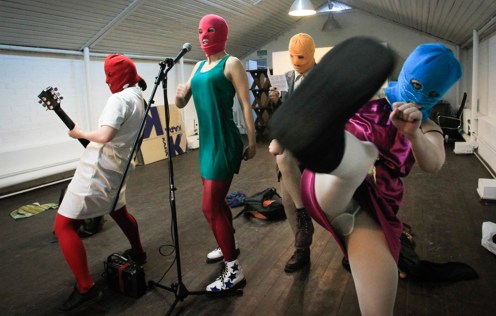
Like the punk music performed by Russian feminist provocateurs Pussy Riot, the documentary that captures their story is an energetic blast of noise and color that is a must-see for anyone into punk-rock, politics or journalism.
Pussy Riot–A Punk Prayer, directed by Mike Lerner and Maxim Pozdorovkin, is a remarkably complete look at the story of three women named Masha, Nadia and Katia, whose arrest for “hooliganism” after an impromptu Pussy Riot performance in a Moscow cathedral turned the world’s attention to modern Russia’s justice system, and the masses who feel the election of Vladimir Putin was reason to hit the streets with some good old-fashioned popular protest.
Pussy Riot formed around the time Putin retook office, in winter of 2011, and came to international attention when they were sentenced to prison for what was essentially a publicity stunt to protest the intermingling of church and state in modern Russia. The film does a decent job in illustrating why people like the trio were appalled at Putin’s return to the presidency, but it excels in showing what a joke the trial of the three young women was.
The access allowed the filmmakers–and the press in general–is amazing, and the film is full of great visuals of the media crowding around the young women in court, of protesters dressing in Pussy Riot’s “uniform” of balaclavas, tights and summer dresses taking to the streets, and of religious folks appalled by what Pussy Riot did in their sacred cathedral. Interviews with the band members and their parents go far in showing us how these young women came to be politicized to the point of picking up guitars and going after the most powerful man in their country.
Even if you’ve kept up with the Pussy Riot story from afar, Pussy Riot–A Punk Prayer is essential viewing. From practice sessions to the appeals court, the filmmakers were with them the entire way through their saga, and this movie will prove a document of true historic import to anyone interested in the intersection of art and political protest.
Even if you never hear another Pussy Riot song after leaving the theater, you’ll find yourself wanting to join their cause at least in spirit, if not in deed.
Remaining screenings:
Jan. 23, 9 a.m., Temple Theatre, Park City
Jan. 24, 6 p.m., Egyptian Theatre, Park City
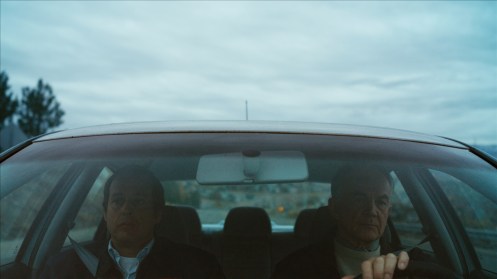
In many ways, This Is Martin Bonner is a perfect representation of a “Sundance movie.”
It’s a subtle character study, featuring a cast of unknowns, and will never be a Megaplex popcorn flick. Those are all positives–but the fact is, not enough actually happens to the characters in director Chad Hartigan’s second feature film to make This Is Martin Bonner worth recommending.
The story, such as it is, tracks one Martin Bonner (played by Paul Eenhoorn), a divorced Australian ex-pat who just moved from Maryland to Reno, the only place he could find a job. And it’s not much of a job at that; Bonner works for a Christian organization helping recent parolees re-enter the world outside of prison. It’s in that role that he meets Travis (Richmond Arquette), just released from 12 years behind bars for a drunk-driving manslaughter case.
Both men are new to Reno, and form a believable friendship through their respective trials in the city. For Bonner, that includes speed-dating nights organized by his faraway daughter. And for Travis, it’s working a boring job as a parking lot attendant and trying to reestablish a relationship with his daughter in Arizona.
Both Eenhoorn and Arquette offer strong performances, and there’s some pleasure to be had watching their friendship development over the course of the film. And while I can appreciate that the film isn’t trying to make any huge statements about issues that seem open to just that–Christian forgiveness, the U.S. penal system, father-daughter relations–there’s just not enough drama taken on to make the movie’s end feel satisfying.
Instead, when This Is Martin Bonner finishes, the audience is left wondering–what was the point?
Remaining screenings:
Jan. 22, 3:30 p.m., Redstone Theater, Park City
Jan. 25, 5:30 p.m., The Marc, Park City
Jan. 26, Noon, Broadway Centre Theater, Salt Lake City
In what is a good barometer for the gun fight that lies ahead, 1,500 Utahns swarmed up Utah’s Capitol Hill to proclaim their willingness to fight tooth and Glock President Obama’s initiative to tighten gun laws. The defiant gesture was repeated in state capitals across the nation.
 Meanwhile, the gun-control advocates across the country clicked their mouses on online petitions.
Gun lobbyist Clark Aposhianproclaimed to “bedwetting, hand-wringing liberals”:
“…Thomas Jefferson anticipated you and called you a tyrant. And there’s already a method of taking care of it, if not by the First Amendment, then by the Second.”
The gun issue has obviously become a lightning rod for the nation’s widening political divide. The gun control advocates may have media, political and marketing expertise—but, so far, they lack the passion, energy and, as gun nuts hint–the firepower of their opponents, including state Rep. Curt Oda and his best friend, right.
As far as online protests are concerned, the gun guys have that covered too, including a Ruger-sponsored site that will fax your congressman, along with Obama, Biden and the governor.
Are gun control advocates willing to take it to the streets?
Joseph Gordon-Levitt is certainly no stranger to Sundance. He’s been in Park City through the years to support star turns in films like (500) Days of Summer, Brick and Mysterious Skin, as well as promoting his own social network/collaborative production company hitRECord.
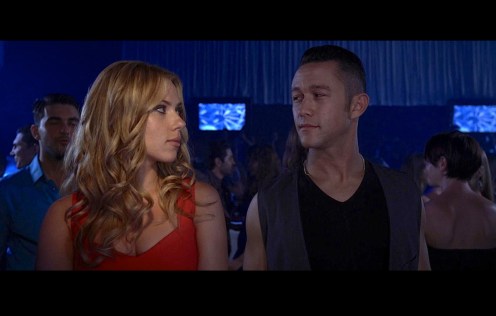
Don Jon’s Addiction, though, marks the young star’s first feature-directing effort, and he also wrote and stars in this story of a Jersey Shore-style mook with a serious “addiction” to pornography, despite the suave guy’s ability to constantly pull “10s” at the club.
That includes one Scarlett Johansson as Barbara Sugarman, who manages to wrangle Gordon-Levitt’s character, Jon Martello, into a genuine relationship. I suppose if we’re going to show a so-called “addiction” to pornography, it doesn’t hurt to have a woman like Johansson on hand to illustrate just how driven Jon is to enjoy his online activities.
Gordon-Levitt proves a more-than-capable director, blending rapid-fire cuts to Jon’s favorite Web sites, hilarious scenes at his family’s dinner table (Tony Danza is excellent as Jon’s dad) and a little romance into a nicely paced narrative that, in turns, is funny, touching, even disturbing. Watching Jon and Barbara interact provides some great laughs–often at the expense of New Jersey stereotypes. But when Julianne Moore enters the fray as a fellow student/recent widow in an adult-education class Jon’s taking, and immediately spots Jon as more than what we see on the surface, the film takes a sweet, unexpected turn.
Jon’s “addiction” isn’t treated lightly, exactly, but his porn-cruising sessions are largely played for laughs–until Barbara finds out. And Moore’s arrival as a woman with the experience to explain why Jon’s seemingly innocent obsession is keeping him from satisfying real-world relationships offers a better anti-porn argument than anything any self-described moralist could come up with.
The performances are roundly excellent, from the leads to smaller characters like Jon’s sister and club-hopping buddies. Gordon-Levitt’s attention to detail, from Jon’s apartment, to his family’s offbeat dynamics, to the scenes at the club, is truly impressive.
If Don Jon’s Addiction is indicative of what Gordon-Levitt has to offer as a film auteur in the future, we’re all in store for some exciting work.
Remaining showings:
Jan. 21, 6 p.m., Sundance Resort
Jan. 22, 2:30 p.m., Library Center, Park City
Jan. 26, 12:15 p.m., Eccles Theatre, Park City
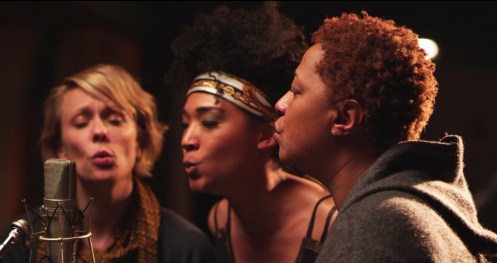
Miramax honcho Harvey Weinstein swooped on Twenty Feet from Stardom immediately after the film helped launched the 2013 Sundance Film Festival, and with good reason.
While much festival fare, whether documentary or narrative in nature, tends to delve into the dark and depressing, the sheer joy of watching the incredible voices on display in this documentary about backup singers is a welcome treat. This film is so full of great music, spanning decades, that it’s impossible to at least not find yourself dancing in your seat a bit during its 90-minute run time.
The film delves into several aspects of the trade, including solo aspirations of the singers involved, the importance of their harmonies to pop music history, and how important these mysterious women are to lead singers like Mick Jagger, Sting or Bruce Springsteen, who all appear in interviews to extol the virtues of the backup singers they’ve worked with through the years. The parts of the film exploring the development of backup groups as a must-have on the pop, soul and R&B music of the ’50s and ’60s, from Ray Charles’ Raelettes to Phil Spector’s dictatorial treatment of Darlene Love, was particularly compelling stuff.
Throughout the film, director Morgan Neville (who some might know from his Pearl Jam Twenty film, or Respect Yourself: The STAX Records Story, elicits great stories from performers like Love, Merry Clayton, Judith Hill and Lisa Fischer, covering everything from their personal ambitions to the sometimes frustrating aspect of always being in the back of the stage, rather than out front. Fischer proves the most interesting; the powerhouse singer is recognized by virtually everyone in the film as a superstar, but she long ago decided she prefers working with groups rather than fronting her own projects.
By the end of Twenty Feet from Stardom, you not only are incredibly educated about the art of backup singing. You are also actively rooting for some of these women to forge forward and earn that stardom that seems so deserving. Love’s arc of Spector plaything to being completely out of music and cleaning houses, to her reemergence as a star and recent inductee into the Rock and Roll Hall of Fame shows that stardom is possible for these ladies. Here’s hoping Twenty Feet from Stardom will help them out when it hits theaters this summer.
Remaining screenings:
Jan. 21, 11:45 a.m., Egyptian Theatre, Park City
Jan. 25, 8:30 p.m., The Marc, Park City
(Photo courtesy Park City Live)
You can bet that around about 1980, there was no way consummate punk frontman Lee Ving would ever imagine sharing a stage with Stevie Nicks from arena-sized corporate-rock faves Fleetwood Mac, or with soap opera actor/pretty boy Rick Springfield.
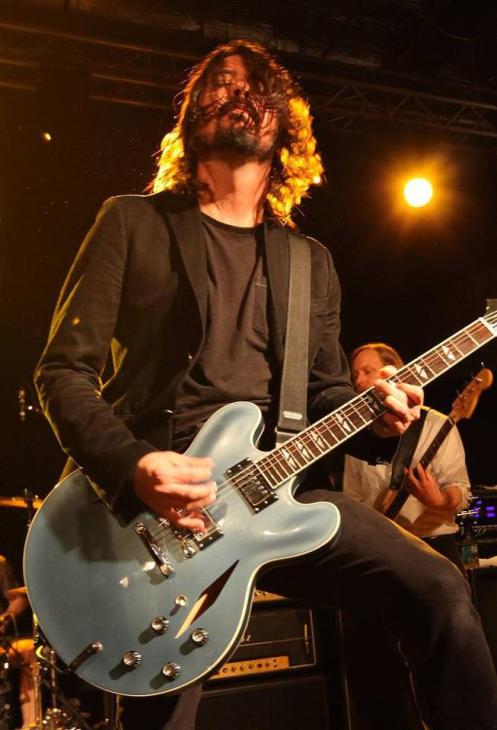
Leave to a man like Dave Grohl–who has comfortably resided in the dingiest of punk clubs back when he was in Scream, and eventually turned into an arena-sized rock star himself after the abbreviated life of Nirvana–to bring such seemingly disparate musicians together. And give him credit for having it all make musical sense when he gathered a supergroup from his Sound City documentary that premiered at Sundance this weekend.
With an ever-changing lineup that included all of the Foo Fighers, Grohl’s old Nirvana-mate Krist Novoselic, his Queens of the Stone Age peer Alain Johannes and some bonus firepower from Cheap Trick’s Rick Nielsen and John Fogerty, Grohl and company delivered a three-hour show that was a blaze through some classic pop and rock–more than three dozen songs in all.
I never thought I’d return to a show at Park City Live (formerly Harry O’s) during Sundance after some heinous past experiences, but the new management was ready for this show. Remarkably, it started a mere 35 minutes after the announced time, and instead of packing the joint to uncomfortable extremes, you could actually move around a bit. Getting a drink was dangerously easy–although dropping $24 for a Full Suspension and shot of High West Whiskey was Sundance gouging at its finest.
The show, though, made any complaints seem ridiculous. Grohl and his guests were obviously having a blast on stage. The early parts of the show were filled with the most obscure tunes–Ving’s Fear stuff and some of Johannes’ own music from Queens of the Stone Age and his former band Eleven.
As the show moved on, the guests and hits got bigger and bigger. Nielsen charged the crowd with his hyper-active persona and stellar guitar on faves like “Surrender” and “Ain’t That A Shame.” Springfield’s time on stage was a pleasant surprise, as Grohl grinned through ’80s hits like “Love Somebody” and, of course, “Jessie’s Girl.”
John Fogerty is one mean guitar player, and he showed just that during a mini-set heavy on the Creedence Clearwater Revival songs; “Born on a Bayou” and “Bad Moon Rising” were both epic highlights in a night full of great performances. Stevie Nicks naturally drew a huge cheer from the crowd, and hearing her and Grohl trade lines on “Stop Draggin’ My Heart Around,” with Grohl subbing for Tom Petty, was one of those special musical moments that can happen at Sundance. “Gold Dust Woman” and “Dreams” weren’t too shabby, either.
The Sound City Players delivered some of the original songs that Grohl recorded for his movie’s soundtrack, and they stood up pretty well next to the cavalcade of classics. But Friday night was all about having one of the best collection of musicians imaginable come together to celebrate the music created at the Sound City studio Grohl pays tribute to in his film.
It’s hard to think of a better way to honor the place’s legacy than the amazing night Grohl put together.
 Daniel Nailen