
I can’t say it’s a surprise that Pioneer Theatre Company’s latest production is good; the theater rarely delivers a clunker. But Laughing Stock was still an unexpectedly pleasing and joyful valentine to theater lovers that proved sneaky in its effective delivery of nearly non-stop laughs, and some heartfelt emotion, too.
Haven’t heard of Laughing Stock? That’s a shame, because it should be a regular theater feature along the lines of Noises Off!, one of the inspirations to Pioneer’s soon-departing artistic director Charles Morey in writing Laughing Stock in the late ’90s. Like that familiar and still-funny favorite, Laughing Stock is a comical “inside look” at a theater troupe, in this case at a summer-stock theater in New England, and the collection of oddball and endearing characters who make up the theater’s actors, backers and technical staffers.
Laughing Stock has been produced for years across the country, and this year’s production at the Pioneer is its first return visit to the theater where the show premiered in 2001. That’s far too long a hiatus, and here’s hoping the show becomes a more regular feature in Salt Lake City programs.
Of course, it will be hard to replicate the success of Pioneer’s current show. Laughing Stock is a true ensemble comedy, with more than a dozen characters involved–most of them given featured spots along the play’s path to shine, or potentially grind the show to a halt. That doesn’t happen at all in this production; indeed, the sparkling cast is remarkably skilled at delivering the combination of slapstick physical comedy and witty, twisting dialogue that blends a little Shakespeare here and a little Noel Coward there, along with plenty of homey, small-town sentiment.

L-R: Paul Kiernan (Henry Mills), Craig Bockhorn (Craig Conlin), Jack Koenig (Gordon Page), Cheryl Gaysunas (Sarah McKay). Photo by Alexander Weisman.
The play kicks off with Gordan Page (Jack Koenig) showing off the charms of his small New England playhouse to an aspiring actor, Jack Morris (Cary Donaldson), who believes he’s destined for better things than a summer gig in a converted barn. Flash-forward a couple months, and Jack is part of the cast of three plays: King Lear, a new version of Dracula and Charley’s Aunt. Joining him are a hilarious assortment of troupe veterans like the elderly thespians Richard Hawksley (Anderson Matthews) and Daisy Coates (Joyce Cohen), a saucy starlet named Mary Pierre (Lesley Shires), a returning leading man, Tyler Taylor (David Christopher Wells) who may or may not have knocked up a co-star the previous summer, and a crusty big-ego and big-time-in-his-own-mind grump named Vernon Volker (Jeff Steitzer).
The cast is consistently excellent; I tried to pinpoint who was my favorite character as the action unfolds on stage, the cast rehearsing for the shows while Gordon hustles theater donors for funds to keep the theater alive, and it was impossible. In on scene Volker’s acidic asides would elicit laughs, and in the next, Taylor-as-Dracula, with his cape caught in a door, is bringing down the house. Paul Kiernan, as set designer Henry Mills, is a gas every time he’s on stage, whether exasperated at trying to create special effects for Dracula, or drunkenly drinking in celebration of the summer’s end. Shires’ Mary was effervescent as well, a mix of sexy and silly that was a blast to watch.
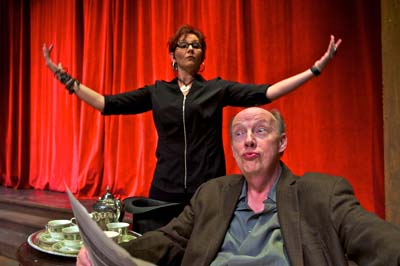
L-R: Kymberly Mellen (Susannah Huntsmen), Jeff Steitzer (Vernon Volker). Photo by Alexander Weisman.
That pretty much goes for the entire show. It’s quick-paced, blasting by in two acts that have the audience cheering for the people on stage to succeed. It’s cleverly staged by Morey (in his director’s hat), and the sets, as always at Pioneer, are impressive. Even when the show delivers a dramatic aside, as when Gordon and his ex-wife/stage manager Sarah (Cheryl Gaysunas) share an intense conversation about the past, it just works.
Here’s hoping that after Morey departs Pioneer, the theater remembers gems like Laughing Stock and brings it around again sometime.
Laughing Stock runs at Simmons Pioneer Memorial Theater through April 7. Visit the Pioneer Theatre Company Website for tickets and showtimes.

For the casual observer who only knows Joan Jett for her monster early ’80s chart-topper “I Love Rock & Roll” and maybe a few other hits of that era, the fact Jett and her band the Blackhearts were headlining the Peppermill Concert Hall in Wendover completely makes sense.
After all, casinos and state fairs are the realm of classic rockers and one-hit wonders, right? And while the plush confines of the Peppermill Concert Hall are certainly a bit sterile, especially as a setting for Jett’s gritty, punky brand of rock, the sold-out show Jett played Saturday night was far from a simple rehashing of past glories.
Yes, Jett delivered the hits over the course of a too-fast 80-minute, 18-song set. But fully half of the set was dedicated to either new, yet-to-be-recorded songs, tunes from the past few years that only the most dedicated of Jett fans have heard, or deep album cuts from her ’80s releases. The preponderance of non-classics is a credit to Jett and the fact she’s still writing aggressive, catchy anthems of the “love you/hate you/fuck you” variety. Some of the new tunes (“Hard to Grow Up,” “Reality Mentality”) worked better than others (the already stale, clunky “T.M.I.”), but I give Jett credit for following her muse, especially in the environment we were in.
Of course, people were there for the hits, and Jett and her rock-solid band didn’t disappoint at all on that front. The opening salvo of “Bad Reputation,” The Runaways’ “Cherry Bomb” and “Light of Day” is the kind of concert-opening troika any band would die for. (A sidenote: “Light of Day” was the title of a flick Jett starred in with Michael J. Fox, as the brother/sister leaders of a Cleveland garage band. Jett is far more believable as a single-mom singer with rock & roll dreams and attitude problems than Fox is as a kickass guitar-slinger. Bruce Springsteen wrote the title tune, and while he’s performed it in concert, Jett’s version outdoes The Boss, hands down).
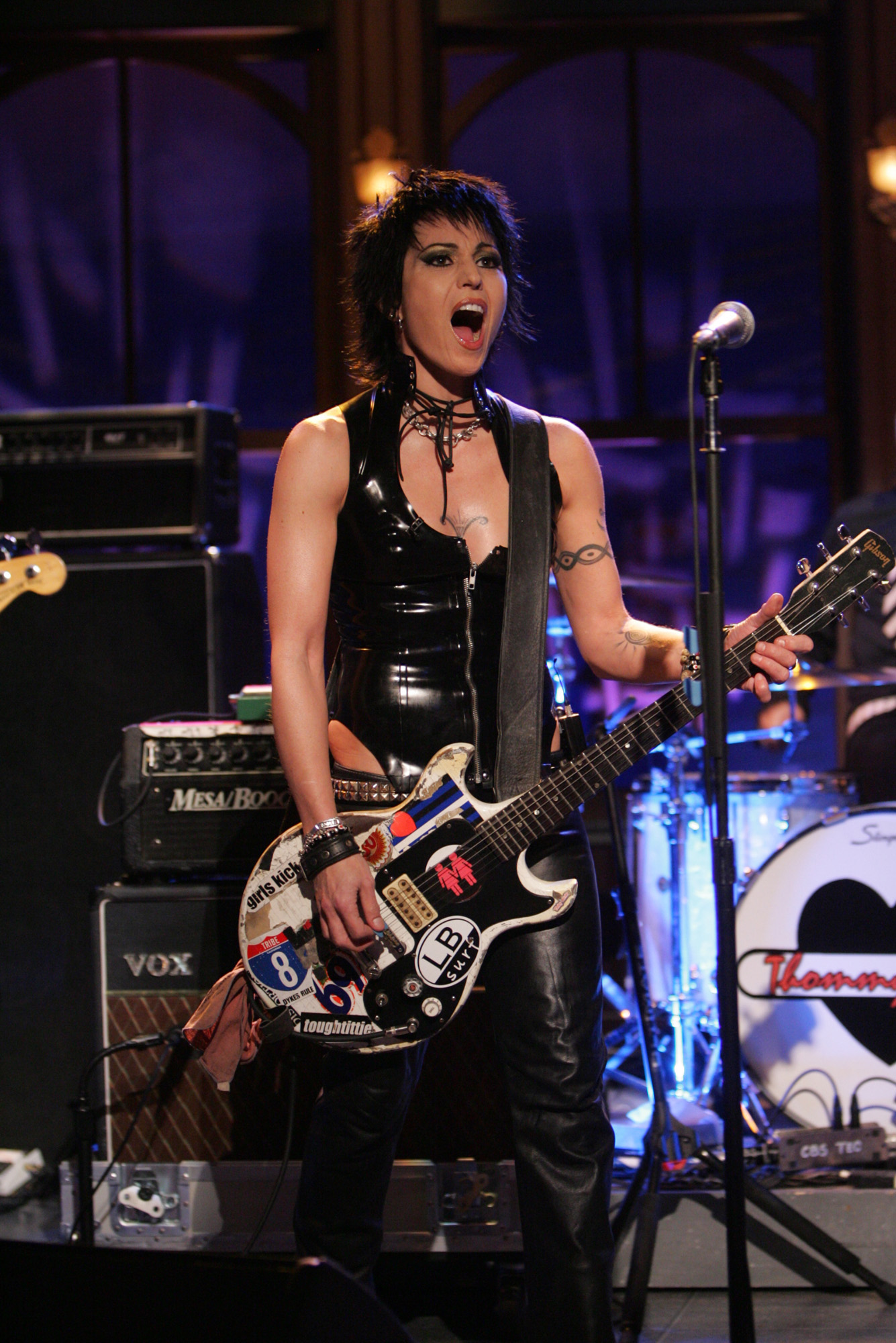
“Do You Wanna Touch Me (Oh Yeah)?” turned into a massive singalong, naturally, with Jett leading the crowd in echoing “Oh Yeah!s” Old favorites like “Victim of Circumstance,” “The French Song,” “Fake Friends” and “Love is Pain” had Jett reaching back to 1981’s I Love Rock and Roll album and 1983’s Album.
After the mid-show section of new tunes and catalog cuts, Jett got back to the monster songs that made her famous. “I Love Rock and Roll” led into a delightfully carnal version of “Crimson & Clover,” which led straight into the set-closing fist-pumping anthem “I Hate Myself for Loving You.”
With one quick encore, “AC/DC,” Jett and Co. were gone after just 80 minutes.
The show was definitely too short, but what we got was really good. And looking around the crowd, it was clear all aspects of Jett’s fan base were on hand. There were hipsters and punks who recognize Jett for the DIY pioneering force she is, a woman who started her own label, Blackheart Records, after being rejected by all the majors after going solo post-Runaways. There was a large contingent of lesbian fans who recognize her as an icon in that community. And there was a whole lot of classic-rock fans who just wanted to hear some of the tastiest American straightforward rock produced by a true unique voice.
And I would bet if you asked any of them, they could have gone for more music from Jett Saturday night.
A few suggestions of some noteworthy music and entertainment around town this week, not including the opening of City Creek, which will undoubtedly offer some entertaining stories from its gala opening party Wednesday night. I don’t think I’ll be making that scene, but I’ll be at a few of these:
William Fitzsimmons at The Urban Lounge, Wednesday, March 21, $15, 9 p.m.
Few singer/songwriters can match the intensity of William Fitzsimmons, a nouveau folkie of sorts whose songs delve into the deeply confessional. Remarkably, the self-analysis of his work comes through via stellar songcraft that takes what is utterly personal to Fitzsimmons and makes it universally thrilling.
KRCL Night Out at Gracie’s, Wednesday, March 21, 5:30 p.m.
If you’ve yet to join the fun at one of these KRCL and Downtown Alliance-sponsored happy hours, it’s time to consider remedying that right now. You’ll enjoy some food specials and drinks with your fellow KRCL listeners as well as a number of the good people to play tunes on the community radio station. This week, the musical theme is soul jams, delivered by DJ Planit and DJ Divine.
Blitzen Trapper at The State Room, Thursday, March 22, $15, 8 p.m.
A few years ago on a visit to Portland, a friend took me to see then-fledgling indie-rock crew Blitzen Trapper. Even at that early stage in the band’s existence, it was obvious how skilled the band was at going in any musical direction main songwriter Eric Earley could think of, and the band’s latest release, American Goldwing, reveals a group still capable of evoking stunning country-folk ala The Band or Neil Young
Laughing Stock at Pioneer Memorial Theater, Friday, March 23-April 7
A comedic inside look at the workings of a theater company, penned by Pioneer’s own outgoing artistic director Charles Morey. Laughing Stock has been produced nearly 100 times across the country in the past decade after premiering at Pioneer, and the funny take on a New England community’s summer season of Hamlet, Dracula and Charley’s Aunt is sure to please theater lovers.
Edward Sharpe and the Magnetic Zeros at Kingsbury Hall, Friday, March 23, $22-$38, 7:30 p.m.
The multi-faceted band led by Alex Ebert is known to give attendees at ther live performances gospel-style “awakenings,” via their brand of folk-pop tunes and Ebert’s Messianic frontman routine. Ask someone who saw them thrill a massive Pioneer Park crowd last summer during the Twilight Concert Series just how powerful they are live.
Anyone who knows me knows I’m not exactly an authority on opera, but I like to check in and see what the Utah Opera is up to once or twice a season. I certainly picked the right show for my first trip of the 2011-12 slate with the current production of Gaetano Donizetti’s The Elixir of Love.

Nemorino and Adina from "The Elixir of Love"
Elixir is a fast-moving romantic-comedy, and while anything “rom-com” is often met by shrieks of disgust and flight from the room by many men, this is the kind of show that should appeal to many not necessarily predisposed to love opera.
The story is a classic, sung in Italian but set in early 20th century Middle America. That bit of playful time-shifting does add to some creative sets and costumes, but doesn’t really add anything to the plot, which revolves around a working-class ice cream man, Nemorino (tenor Aaron Blake), trying to win the heart of the gorgeous Adina (soprano Anya Matanovic) via downing a questionable love potion purchased from traveling huckster Dr. Dulcamara (Rod Nelman). The elixir is supposed to turn the target of one’s affections into easy prey.
The elixir in question is merely wine, but through a funny series of misunderstandings and shifting circumstances that would make an episode of Three’s Company proud, our lovers ultimately find each other. The music delivered by the Utah Symphony is stirring and fittingly playful, and the show seems to fly by–something that can’t be said for every opera, to be sure. Two acts of roughly an hour each, and we get the full, fun story of Nemorino and Adina.
As per usual with Utah Opera productions, the staging and music were ideal compliments to the story, and in The Elixir of Love, the light story suited a cold March night just fine.
Utah Opera’s The Elixir of Love continues its run through Sunday, March 18. Visit ArtTix for showtimes and tickets.
Plan-B Theatre Company‘s productions often rely on strong performances from the actors to help the audience enter a play’s world, rather than ornate production values impossible to undertake in the spartan space in the Rose Wagner Performing Arts Center.
The company’s latest production, the world premiere of The Third Crossing, certainly boasts strong performances from its cast, much of which plays multiple roles in the 80-minute performance. But credit for making The Third Crossing one of the best Plan-B productions of several I’ve seen must go to playwright Debora Threedy, with a strong assist from director (and Plan-B’s producing director) Jerry Rapier.
Threedy weaves an intricate tale of race relations via a script that is part history lesson, part period drama and part modern political screed. And while the show could have veered into preachiness, credit Threedy for making sure it never does, even while making sure her message of equality comes through loud and clear, using both drama and humor along the way.
Threedy’s script bounces between the relationship of Thomas Jefferson (Bob Nelson) and one of his slaves, Sally Hemings (Kalyn West), a history classroom led by a professor (Dee-Dee Darby-Duffin) exploring that controversial bit of American history, and several vignettes in more modern times, including a hate-crime in Salt Lake City’s Liberty Park.

Through all the threads Threedy weaves through her script, what comes through is just how complicated race relations have been in American life right from the very beginning. Even through the strong personal story here of Jefferson and Hemings, in which they argue about their children and try to come to terms with their feelings for each other, there are no easy answers. Jefferson struggles to recognize the needs of his lover and his children by her, and Hemings struggles with her own racial identity even after Jefferson’s dead and she’s a free, elderly woman.
Rapier’s direction keeps The Third Crossing slickly moving along, deftly moving the various characters on and off stage, and creatively changing the scene and era via characters scribbling on a chalkboard. And how many plays have you been to lately that include an audience singalong to help propel the action on stage?
The cast certainly deserves accolades as well, given their collective ability to shift characters on the fly, evoking likeable characters one minute, and virulent racists the next. West deserves special attention for doing much of the show’s heavy lifting as Hemings, a woman whose dignity in the face of unthinkable circumstances gives The Third Crossing its soul.
The Third Crossing runs Thursday, March 8, through Sunday, March 18 at the Rose Wagner. Tickets are $20, available via ArtTix outlets. There are only 90 available as of opening day.
The touring production of Broadway hit Rock of Ages gets a lot right in capturing its story’s time and place—the Sunset Strip in the late ‘80s—but nothing more so than the outrageous, over-the-top spectacle that was the L.A. rock and roll scene of that era.
The show, appearing in Salt Lake City for just three shows in two days, is light and fluffy for sure, but it’s also the kind of high-energy and funny production that makes a night at the theater safe even for non-theater-lovers. When was the last time you saw a theater audience pumping their “devil horns,” playing air guitar or singing along to Bon Jovi’s “Wanted Dead or Alive”? That’s the kind of thing that happens during a Rock of Ages performance, and the result is a genuinely fun night out, especially for people who lived through, or have an affinity for, the hair-metal heyday of bands like Poison, Whitesnake and Warrant.
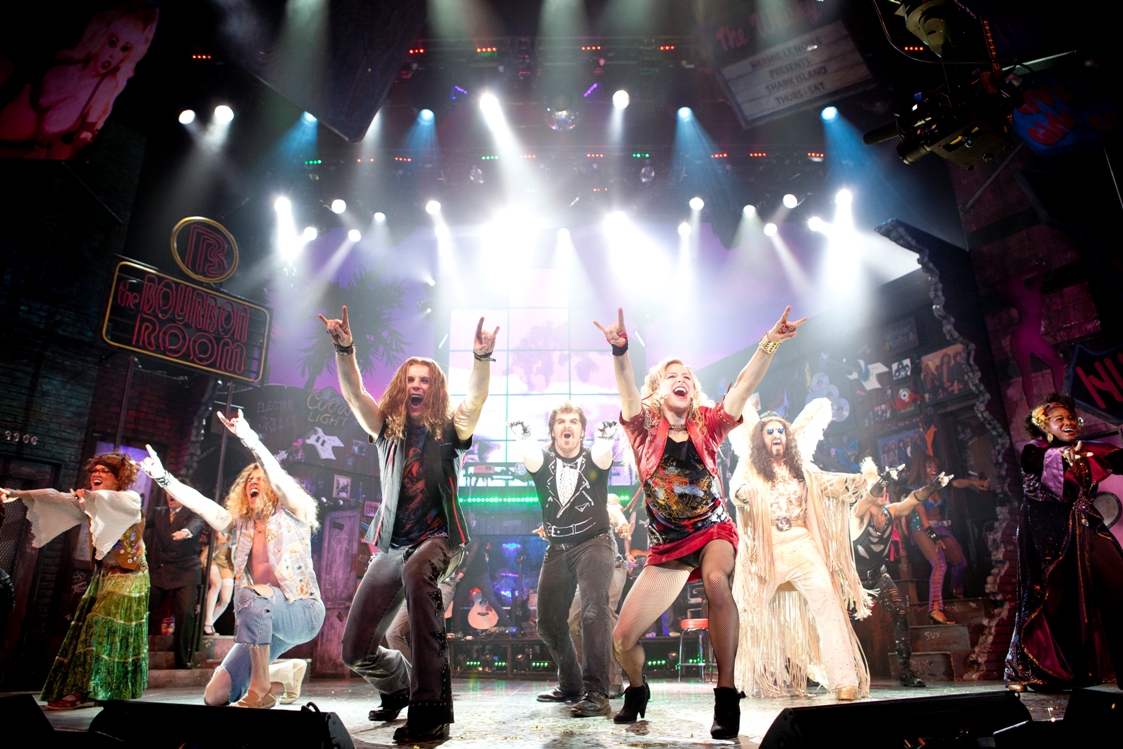
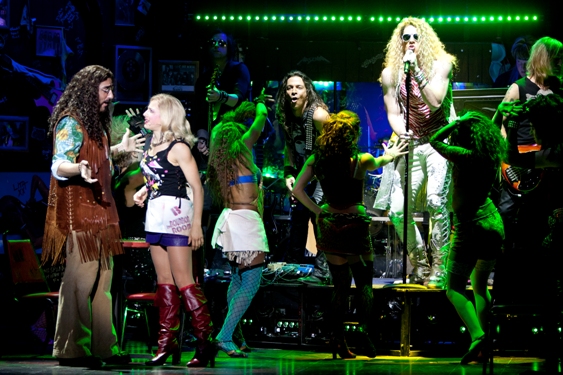
Rock of Ages’ success depends primarily on the audience’s love of the music, with dozens of familiar hits delivered throughout its two acts by characters ranging from Sherrie (Shannon Mullen), the wannabe actress who just showed up in LA, to aspiring rocker Drew (Dominique Scott), to grizzled hippie club owner Dennis (Matt Ban). But a simple-yet-satisfying story gives those songs a solid footing that makes Rock of Ages much more than simply a cock-rock revue.
In fact, you could find the roots of the main love story between Sherrie and Drew in the video for Poison’s “Fallen Angel.” The small-town girl Sherrie hops a bus to Los Angeles full of dreams of an acting career, only to get chewed up by shady movie producers and egotistical lead singers before she ends up as an exotic dancer. At the same time, Drew finally finds the courage to write his own songs, inspired by his desire for this new girl in town, only to be taken advantage of by shady music managers who try to turn him into a boy-band pop star. In the meantime, developers want to level all the rock clubs on the Sunset Strip in favor of a “clean and safe” street of strip malls just as the famous band Arsenal is slated to deliver a farewell performance at Dennis’ club.
Will Sherrie and Drew survive their trials and find love together? You can probably guess, but the predictability doesn’t make it any less fun to see how they and the other characters navigate the Sunset Strip via the lyrics of, say, Night Ranger’s “Sister Christian.” The protesters trying to save the Strip’s historic rock clubs turn Twisted Sister’s “We’re Not Gonna Take It” into an appropriate protest song, and Drew’s emotional version of Warrant’s “Heaven,” turned into a gospel show-stopper, was far more listenable than the actual original song was when it came out.
Throughout the performance, I caught myself wondering if I was laughing AT Rock of Ages, or WITH Rock of Ages, and ultimately it was a little of both. The show is certainly full of self-referential gags, such as when one character mentions John Sununu, and another replies, “Hey, nice ‘80s political reference!” And the character of Lonny (Justin Columbo), who acts as both the club soundman and Rock of Ages narrator, is hilarious from the very start of the show, when he tells the audience, “We’re going back to a sexier time—the Reagan era!” Every time Lonny hit the stage, the audience reacted noisily and happily.
Most of the performances were strong; Mullen’s Sherrie was the highlight among the main characters, although burned-out Arsenal lead singer Stacee Jaxx (Matt Nolan) was always worth watching when he was on stage. Scott’s Drew was a little timid, and his vocals couldn’t reach the same thrilling heights as his co-star Mullen. And when Amma Osei entered the show as strip-club owner Justice, belting out Pat Benetar’s “Shadows of the Night,” it made every other voice on stage seem flat and weak in comparison—that woman can wail!
The set captured the time and place as well as the music did, and the omnipresent rock band on the club’s stage was a highlight of the show. Hell, even the pre-show message to turn off cell phones, delivered via a recording by Whitesnake singer David Coverdale, was hilarious.
Rock of Ages won’t necessarily change your life, but it offers a couple hours of laughs and the chance to relive one of the more inexplicably popular eras of rock music via its soundtrack (Did we really keep listening to Survivor after “Eye of the Tiger”? Rock of Ages offers proof positive). It’s bawdy, silly and ultimately a pretty satisfying experience that is true to its era. Enjoy it while you can (meaning before the Hollywood version hits movie screens this summer).
Rock of Ages completes its Salt Lake City stop Saturday with shows at Kingsbury Hall at 2 p.m. and 8 p.m. Tickets range from $35 to $62.50, and are available by calling 801-581-7100 or visiting KingsburyHall.org.
 Daniel Nailen