 In a state known for its passive-aggressive culture and reality defying myth of political civility, Senate contender Scott Howell’s ageist attacks on Orrin Hatch are refreshing (which translates to “offensive” to old-line Utah politicos).
Hatch is 78 (though he reads at an 81-year-old level). Howell sent out a fundraising email that actually speculated on the probability of Orrin kicking the bucket in office:
“Look, Orrin Hatch is not a bad guy. But he’s an old guy. … We cannot risk the possibility of an 80-year-old man taking office, only to retire or die before his term is through.”
To ratchet up the offensive index even more, Howell presumptuously reminded Orrin that LDS general authorities are “released” at age 70.
Howell is challenging Hatch to release five years of medical records. (Are we ready to review at least two senatorial colonoscopies!)
Utah’s equally aged former Senator “Uncle Bob” Bennett told the Tribune‘s Tommy Burr that U.S. lawmakers, including South Carolina Sen. Strom Thurmond, live forever (or at least seem like it). But life being what it is, Bennett points out that Howell, himself, could dance a last waltz with the Grim Reaper while in office.
 Apparently, nobody told Howell that besides tens of thousands of dollars in campaign contributions, Utah’s supplement industry has been dosing Orrin’s Metamucil with monkey gland extract (which, thanks to Orrin, doesn’t need FTC approval).
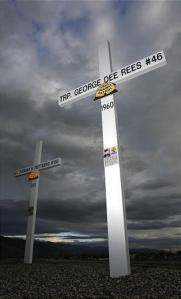 No flag is flying at half mast at the Capitol this month, but one of Utah’s foremost defenders of the Constitution has died.
Over the years, I interviewed Brian Barnard, who died peacefully in his sleep earlier this month, a dozen times. For a guy who infuriated so many people, he was anything but a firebrand. Barnard would gently explain the complexities of whatever civil rights case he was pursuing to dense reporters, judges, panhandlers and politicians.
When the opposition bent and subverted the facts, Barnard never accused anyone of lying. Instead, he would say, “That statement is something other than the truth.”
I was always amused at how much Barnard annoyed Utah’s conservative legislators when you consider he likely treasured their oft-invoked Constitution far more than they did. Maybe it was because Barnard applied the principles of the sacred Founding Fathers to bums, women, Indian tribes other groups Utahns considered outsiders.
Barnard aided the Summum religion (which has a pyramid on SLC’s westside and believes in mummification of the dead) when it wanted its sacred Seven Aphorisms to have the same visibility in public spaces as the Ten Commandments. He successfully worked with atheists to block the placement of 10-foot crosses on public property along Utah’s highways by arguing that annoying principle of separation of church and state—in Utah of all places. And he found time to defend the Girl Scouts’ cookie sales in Lehi from being banned under a poorly written anti-solicitation law.
One evening years ago, I was sitting near Barnard at a Utah Department of Alcoholic Beverage Commission hearing on revamping—yet again—Utah’s liquor laws. At one point, speaking as a taxpayer, Barnard advised against a certain modification. “The Legislature can do anything it wants to, of course,” he allowed. “But you’ll just bring me a lot of business.”
At a legislative committee meeting later, a rookie lawmaker suggested his panel run the liquor-law changes by Barnard to save themselves a lot of trouble—since they regularly paid Barnard’s bills when he won in court. The innocent’s reward was icy silence from his colleagues. He was, of course, correct—his suggestion would have saved them a lot of heartburn.
I’ve begun collecting news items that I call “Things that Would Make Brian Barnard Smile.” Here’s one, an American Civil Liberties Union suit defending a non-denominational church’s constitutional right to use public sidewalks to pass out literature challenging Mormon beliefs during the open house for the city’s new LDS Church temple.
The Utah Legal Clinic that Barnard founded issued an apt epitaph on his passing:
A skilled attorney, Brian spent his career advocating for those who lacked a choice or the power to do so on their own. Among others, Brian represented homeless panhandlers, women denied access to a myriad of institutions on account of their gender, members of unpopular faiths, prisoners forced to live in deplorable conditions and victims of police brutality. We live in a more just world for his having been with us.”
SOPHOCLES’ ANTIGONE, RED BUTTE GARDEN, Saturday-Sunday, 9 a.m., $15/$10 for Red Butte Garden members
Let me first relay my appreciation that this presentation of the Classical Greek Theatre Festival occurs at 9 a.m., not the break of dawn as those Greeks would have done in the old days. This year’s production is Sophocles’ Antigone, a play that has remained popular thanks to an action-filled plot, complex characters, politically and philosophically intriguing ideas and its look at 5th century Athens. This production by Westminster College is directed by Larry West, includes original choreography by Darlene Casanova and a recent American translation by Marianne McDonald. The production also runs next weekend on Saturday and Sunday in the Red Butte Garden amphitheater.

THE HEAD AND THE HEART/BLITZEN TRAPPER, THE DEPOT, Friday, 8 p.m., $20
If it seems like The Head and the Heart have been on the road forever, well, that’s pretty accurate. The Seattle band’s visit to Salt Lake City Friday is part of their third headlining tour in support of their 2011 self-titled debut, and they stopped here to open for The Shins at Red Butte Garden this summer as well. If they want to keep coming around every 6 months or so, I’ll take it, because the band’s album was one of my favorites of 2011, and their show at Kilby Court was brilliant. Joining them is the also-excellent Blitzen Trapper, fellow frequent visitors to our fair town, most recently opening for Wilco this summer. Bryan John Appleby, who shares The Head and the Heart’s hometown, opens the show.

SALT LAKE CITY FILM FESTIVAL, VARIOUS LOCATIONS, Thursday-Sunday
You’ve gotta love the fact Utah’s capital has a plucky up-and-coming film festival all its own, and it’s happening this weekend. You can find a diverse slate of indie flicks all weekend at the Broadway, the Tower and Brewvies Cinema Pub, ranging from films like Duck Beach to Eternity, about young Mormon singles, to flicks like Intro, a doc about Utah musician David Williams that was nominated for Best International Documentary at Italy’s Torino Film Festival–check out a trailer for Intro right here. And the fact that it includes Color Me Obsessed, a Replacements documentary I’ve been waiting to see for a while, makes this a must-do this weekend.

 In The New York Times, philosopher Simon Critchley scolds his “horribly overeducated and hugely liberal” New York friends for their casual but incessant bashing of the LDS religion. So far, so good in his essay, “Why I Love Mormonism.”
But Mitt Romney probably wishes Critchley stopped there.
Critchley explains:
… when anti-Mormon prejudice is persistently pressed and expressed, and I perhaps feel momentarily and un-Mormonly emboldened by wine, I begin to try and share my slim understanding of Joseph Smith and my fascination with the Latter-day Saints. After about 45 seconds, sometimes less, it becomes apparent that the prejudice is based on sheer ignorance of the peculiar splendors of Mormon theology.
He goes on (and on) to explain some of the more arcane of splendors of Mormon belief (BTW: The NYTimes is not The Salt Lake Tribune religion page, so expect a fascinating but challenging intellectual discussion, requiring thinking and stuff).
In the process, Critchley probably doesn’t build any bridges between Mitt and the GOP’s Evangelical Christians. Lord knows they already view his all-American religion with suspicion.
Critchley gave a series of lectures at Brigham Young University in the mid-1990s and he shares a few things he learned during his stay in Provo:
— For a start, God did not create space and time, but is subject to them and therefore is not an infinite being.
— Any male Mormon can inherit the same “power and glory as God and become exalted like him.” Or as another Mormon leader pithily explained it: “As man now is, God once was. As God now is, man may be.”
— Smith’s explanation of the thorny Holy Trinity relationship likely would have gotten him burned at the stake in the 16th Century.
In short, Critchley’s valentine to the Mormon religion is complex and thought provoking and isn’t any stranger than transubstantiation or virgin birth. But the essay also clearly explains why Mitt Romney, who presumably believes he has a shot at godhood, hasn’t committed a lot of time explaining his religion to the Evangelicals he needs to win the somewhat less exhalted post of president of the United States.
 Daniel Nailen