DELTA RAE, ECCLES CENTER FOR THE PERFORMING ARTS, Park City, Saturday, Feb. 2, 7:30 p.m., $20-$67
North Carolina’s Delta Rae is based around the kind of mesmerizing vocal harmonies that only seem to come through family ties–think the Beach Boys. Except in this case, you have the boy-girl harmonies of Ian, Eric and Brittany Holljes, along with childhood friend Elizabeth Hopkins and a rhythm section that joined in 2010–altogether, Delta Rae delivers more of a countrified Fleetwood Mac vibe, with touches of blues and soul in the mix. They’re slick; anyone who is more a fan of gritty Americana might find them a little too slick. But fans of mainstream country acts like Lady Antebellum will find plenty to love in Delta Rae’s songs. And if you need any hipster cred to decide to go–Delta Rae was landed by Warner Bros. exec Seymour Stein–the man who signed Talking Heads and Madonna way back when.


The world premiere of Plan-B Theatre Company’s production of Adam & Steve and the Empty Sea will surely strike a chord with anyone appalled by California’s Proposition 8 and the LDS Church’s well-documented efforts to fight gay marriage in order to “save the family.”
Thankfully, playwright Matthew Greene’s two-man show doesn’t devolve into mere political speechifying as the title characters navigate their respective journeys into adulthood, and into their true selves. Rather, Greene shows, through their story, how true friendship and love can transcend different sexual orientations, different religious backgrounds and different political persuasions.
It’s a bumpy road the characters have to take to reach that conclusion, and the audience sees Adam (Topher Rasmussen) and Steve (Logan Tarantino) bounce between adolescence and young adulthood via a series of vignettes that range from playful silliness to intense screaming matches as they alternately feel concerned for each other and blame each other for some of the trials each encounters while growing up.
Both actors do a fine job in drawing the audience to their characters’ corners, and Greene gives them some excellent scenes to work through, full of utterly believable dialogue and enough dramatic twists to keep the audience interested through the 90-minute running time.
Adam & Steve and the Empty Sea is at its best when Greene juxtaposes one powerful scene of Steve coming out to his lifelong friend Adam with a later, even more powerful passage when Adam tells Steve he is going to go on a mission rather than join him at USC for what would have been their freshman year of college. It was a touching twist, and a fine illustration of how some people react just as strongly to someone finding a religious faith as other do to someone coming to grips with their homosexuality.
The actual Prop 8 fight is only featured in one scene of many, serving as a nice dividing line between the friends’ childhoods and division into separate adult paths, albeit briefly. The play doesn’t lack anything for it, though, raising plenty of questions about the nature of love and friendship that linger after the lights go down.
Plan-B Theatre Company’s Adam & Steve and the Empty Sea runs Thursdays-Sundays until Feb. 10. Tickets are $20, $10 for students, and are available via Plan-B’s Website or ArtTix outlets.
(Photo courtesy of Rick Pollock)
Matt Pacenza, policy director for the Healthy Environmental Alliance of Utah (better known to some as HEAL Utah), took in Sundance Film Festival documentary Pandora’s Promise, a film that tracks some environmentalists’ shift to believing nuclear power is a legitimate energy solution after years believing otherwise. Below is Pacenza’s take on the film.
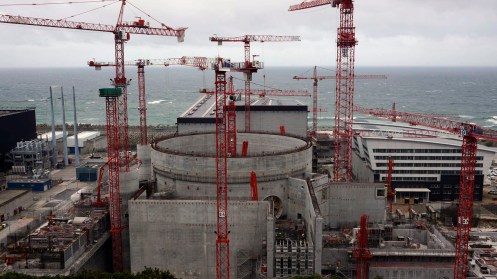
At the heart of Pandora’s Promise – a new documentary film from award-winning filmmaker Robert Stone which debuted at the Sundance Film Festival this past week – is the notion that where we get our electricity is the most fundamental issue humanity has to grapple with.
At HEAL Utah, a non-profit which focuses on nuclear and energy issues, we couldn’t agree more: Starting with the effects of climate change, and moving into the existential question of the long-term sustainability of modern civilization, how we choose to power our world is critical.
Which is why Pandora’s Promise is ultimately such a disappointing film. It’s a study of a half-dozen well-known environmentalists who have come to embrace nuclear power as the solution to the world’s climate and energy crisis – after having shunned it for years, like most of the green community still does. While the exceptionally well-made film has its provocative moments, the gaps in its focuses and its reliance on cheap propaganda ultimately doom it to little more than a clever piece of agit-prop.
The film’s nearly exclusive focus is on what it posits are the wildly-exaggerated dangers of nuclear power. Pandora’s Promise hammers home one main message: Nuclear power is relatively safe, especially when compared to fossil fuels, which indisputable kill tens of thousands of people a year. The film argues that the nuclear industry’s trio of high-profile accidents — Three Mile Island, Chernobyl and Fukushima – in fact was much less devastating to public health and the environment than is popularly believed.
Now, we can dispute that notion: There is decent evidence suggesting that not just nuclear accidents but day-to-day operation of nuclear power may be harmful. But, even if we acknowledge that Stone and his cadre of pro-nuke evangelists have a point, it’s odd how the film proposes that safety issues are the only concern of the anti-nuclear community.
There is a very brief discussion of nuclear waste, which is ultimately superficial and unsatisfying. No mention of low-level waste, for example, an issue that matters in Utah, home to the nation’s large such dump site. No mention of the uranium fuel cycle, the pollution generated by mining, milling and processing the fuel needed for nuclear power.
Water also never comes up – another glaring omission in Utah, where the massive amount of water nuclear power needs has emerged as the key issue in the battle over the Green River reactors. Given that so much of the world’s future will be shaped by the availability of water, it’s strange to not mention that as a factor in decisions about where we get our electricity. It’s like making a film about the future of agriculture without discussing soil.
And, most bizarrely, money never comes up. One would assume, after watching Pandora’s Promise, that the main reason we haven’t built more nuclear reactors is because of the fear of accidents. Irrational hysteria explains the lack of success nuclear power has experienced over the past 30 years, after its boom in the 1960s and 70s, the film suggests.
Of course that’s not true: Cost is what has doomed nuclear. Despite significant subsidies, the power the industry makes is simply too expensive, especially when compared to coal and natural gas. If you go and talk to the people who actually make decisions about how to make electricity, you won’t have lots of conversations about reactor cores melting down, but you will discuss skyrocketing pricetags and construction delays.
Lastly, and perhaps most depressingly, the film asserts we need nuclear because it’s the only alternative. Its pro-nuke environmentalists – like so many of us – are very worried about carbon, about our warming planet and about how we will generate enough electricity to rapidly move away from coal- and natural gas-fired electricity.
What about renewables? What about wind, solar and geothermal energy? The quick way the film dismissed those sources is disappointing, and kind of sad. “What do you do when the wind doesn’t blow and the sun doesn’t shine?” one voice in the film posits, as if intermittency is an unanswerable problem that will forever doom renewables. No mention of energy storage, which is growing increasingly viable.
The film notes that renewables and energy efficiency don’t yet contribute much to our overall energy pictures, but accepts that reality as a death sentence, rather than largely-political obstacles which can be overcome.
The film may fail to engage with most of the issues surrounding nuclear power, but what also makes it ultimately unsatisfying is the gimmicks it uses to prop up its side of the nuclear debate. The pro-nuke environmental evangelists are shot beautifully, often in soft focus. They’re handsome, and are frequently shown strolling along the beach, playing with their families and sitting in their homes and offices.
Its best voices – American Michael Shellenberger and Brit Mark Lynas – are young, and very well-spoken. Each makes his pitch very artfully, explaining how he slowly transformed from hating nuclear power to embracing it. They’re likeable guys, experienced activists and deep thinkers whose portrayal screams thoughtful and reasonable.
The anti-nuke folks, on the other hand, are shown nearly exclusively in protests. While demonstrations may be a valuable activism tool, the rhetoric and images they produce are admittedly not terribly nuanced. The footage of those protests – depicting puppets, drums and the unkempt activists chanting and singing – stands in sharp contrast to the careful, warm, sympathetic voices of the pro-nuke crowd.
An anti-nuclear activist is interviewed just one time in the film – and the moment sadly shows Stone’s lack of faith in his own theses. He interviews prominent anti-nuclear activist Helen Caldicott, 74. However, Caldicott’s interview clearly wasn’t scheduled – nor is she allowed to explain herself at length. She is apparently ambushed, as she leaves a demonstration where she had spoken.
Caldicott is asked several pointed questions about why she doesn’t believe health studies which indicate the health toll of the Chernobyl disaster was fairly low. And, frankly, in her hurried responses, she comes across poorly, fearful of science and stuck to her pre-conceived notions about scary nuclear power, regardless of the evidence.
The message is clear: Who do you believe? The handsome, rational folks who thoroughly explain how they came to support nuclear power – or the bedraggled activists who hate facts?
If Stone really wanted to provoke a debate among environmentalists about nuclear power, he’d treat each side with respect. He’d interview people in similar ways, and give them a chance to speak at length. He’d grapple with the wide range of issues that nuclear power raises – not just safety, and waste, but water usage and cost. And, lastly, he’d engage in a more informed discussion of alternatives, especially renewables.
–Matt Pacenza

Ah, the folly of high expectations at a Sundance movie.
Every year, there’s at least one movie that seems like a slam-dunk, an easy call on whether or not to see it, based on its cast, subject matter, writer or director. And every year, at least one of those supposed automatic winners turns out to not quite live up to my self-made hype.
This year, that movie is A.C.O.D., a dramedy written and directed by Stuart Zicherman, about one man dealing with being an adult child of divorce. I didn’t know anything about Zicherman going in–his background is in action films like Elektra and Rush Hour 2–and it was the cast of comedy all-stars that drew me to A.C.O.D. After all, how can you go wrong when a movie features Adam Scott, Catherine O’Hara, Richard Jenkins, Amy Poehler, Jane Lynch and Clark Duke–all actors I’ve seen and loved in comedies for years?
A.C.O.D. doesn’t exactly go wrong so much as it never achieves complete comedic lift-off. There are some solid one-liners, winning episodes throughout the film, and the actors are all in fine form, yet I found myself going long stretches between laughs–too long. That said, the dramatic side of the movie was stronger than anticipated and I’m sure many actual adult children of divorce will find plenty to connect with in the story of Carter (Scott), who has spent a lifetime as the referee between his warring parents (Jenkins and O’Hara) and emotional guardian of his little brother Trey (Duke).
The story is set in motion when Trey gets engaged, and Carter sets out to get his parents to be in the same room together for the first time in 20 years. For help navigating the rocky emotional terrain, Carter goes to his childhood therapist (Lynch), who he now discovers is actually an academic who was using her discussions with the adolescent Carter for fodder for a book on children of divorce. Now reconnected, she sells Carter on the idea of exploring his adult life as he still deals with his parents’ apparent disdain for each other.
Lynch delivers another strong, small character here, as does Poehler as Carter’s bitchy stepmother. O’Hara and Jenkens are both excellent as the angry exes who find themselves once again drawn together through their kids, and Scott has the befuddled everyman act down cold, as anyone who watches him with Poehler on Parks & Recreation already knows.
Despite the cast’s efforts, though, I couldn’t help thinking A.C.O.D. didn’t live up to the potential of that cast to be more laugh-out-loud funny that simply droll and amusing. That’s the fault of the script, not the cast. Scott’s Carter carries the film, and he’s the least funny character, too often simply the straight man to the secondary characters’ better gags.
While A.C.O.D. aims to make divorce funny, and manages to show its possible in flashes, it doesn’t ultimately succeed.

One of Sundance’s favorite filmmaking teams, director/writer Zal Batmanglij and actress/writer Britt Marling, premiered “The East,” a sharp, enviro-spy thriller that you’ll likely be seeing in art theaters later this year.
Sarah Moss (Marling) is an undercover agent for a private security firm that contracts with companies to eliminate “terrorist” threats, including American activist groups. Moss, who could hold her own with 007, is sent out to bring down a mysterious cell of radical environmentalists called The East.
“The East” is an Earth First!er’s fantasy. The freegan group lives off the bounty of dumpsters (Batmanglij and Marling say they lived as freegans for three months to research the script) while carrying out actions against large mining and pharmacuetical corporations. The East gives the evil greedpigs a dose of their own medicine, literally. The top brass of a drug corporation has their wine dosed with the the company’s vaccine that has been found to have horrific side effects. A mining exec is forced to swim in his power plant’s carcinogenic effluent. Eew.
Moss is won over to The East’s objectives, but has a moral dilemma with the group’s means to an end—is it OK to hurt or kill those who poison the earth, even if you do it with their own poisons?
“The East”‘s ending is somewhat of a cop out, perhaps to prevent the film from being labeled an anarchist’s cookbook for environmentalists.
I had to wonder if “The East”‘s enthusiastic audiences noticed that the mountains around them are scarred with ski slopes.

When Truman Capote heard that Jack Kerouac had typed “On the Road” without rewrites on one continuous roll of paper cranked through his typewriter, Capote dismissed it, saying: “That’s not writing—that’s typing.”
If anything, the biopic “Big Sur,” premiering at Sundance suffers from too much polish and too little motion.
Director/screenwirter Michael Polish’s lushly filmed “Bg Sur,” based on Kerouac’s book of the same name, picks up the author’s life a few years after “On the Road” catapulted Karouac to fame. He’s become an American icon forever hitchhiking across the continent and the Beat movement has become a caricature. Jack’s battling black moods, alcohol and writer’s block.
Jack (Jean-Marc Barr) heads out for his pal Lawrence’s Ferlinghetti’s primitive cabin at Big Sur to heal. Unfortunately—to take the movie at its word—Jack learns upon arriving in San Francisco that his cat has died. The news sends him on on a bender fueled by cheap port wine, cigarettes, fear of death and self pity.
For the rest of the movie, Jack stumbles around in front of breath-taking scenery and a cast dressed in full-on “Mad Men” casual-Friday style and driving classic ’50s automobiles. Beset by his demons, delirium tremors, Neil Cassidy’s annoying mistress and cosmos-shaking hangovers, Jack spews forth a torrent of not-half-bad prose that will become his 1961 novel “Big Sur.”
Spoiler alert: The film ends on a happy note reminiscent of Scarlett O’Hara’s “tomorrow is another day” outlook. (And you think I’m kidding.)
Any film this well made with the acting muscle of Jean-Marc Barr, Kate Bosworth, Radha Mitchell and Anthony Edwards is destined to make it to the art houses.
 Daniel Nailen