MICKEY HART BAND, THE DEPOT, Tuesday, Feb. 26, 8 p.m., $35
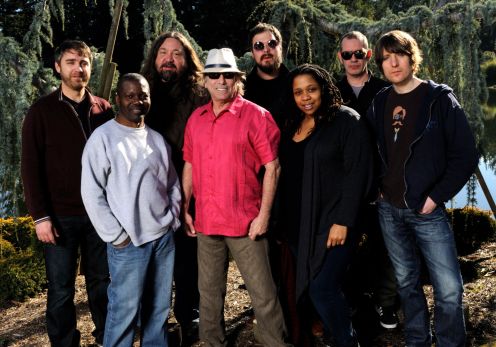
Suffice to say, Grateful Dead drummer extraordinaire Mickey Hart doesn’t need any help filling a venue for a live show with his name attached. But you can imagine that if the impressive percussionist was so enthralled by the Ghana-based African Showboyz when the group joined his for three shows at the end of 2012 that he recruited them to join them on his current winter tour, they must be something special. That group’s blend of West African rhythms and dance moves will be a major part of the show Tuesday; not only will they open the show with their own set of tunes, but they’ll join Hart’s band as well, turning it into a 12-piece ensemble with no less than seven percussionists and seven vocalists. Together, they’ll tackle tunes from Hart’s new Mysterium Tremendum album, as well as faves from the Grateful Dead catalog. In other words, prepare to get on your feet and stay there once the music starts.
 If you’re one of those rare Utahns who doesn’t hang out with died-in-the-wool gun nuts*, you’re probably not familiar with their strange and beautiful speech patterns, developed through years of living in an echo chamber with other paranoiacs.
It was at full volume Friday at the Utah Legislature’s Judiciary Committee meeting where HB114, “Preservation of the Second Amendment,” was being bloviated.
The speechifying of the gun fringe, all of whom consider themselves constitutional scholars, seems to be an attempt to ape the meter, metaphors and passion of 18th Century colonial propaganda.
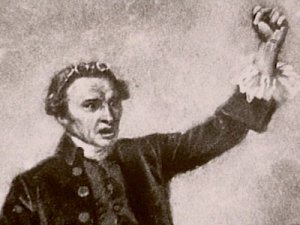 As one citizen told the committee:
“I implore you to see the greatest threats stem not from your neighbors or the lone gunman–but from the malicious intents permeating from corrupt government! The product of gun control is summed up in history and the equation is mass death and the dark legacy of tyranny! The opposition to tyranny of words and ideals alone is fierce, but it is a cat’s meow to the lion’s roar if backed by rifles and bullets and free people united with the discipline to wield such weapons!”
Wow. It’s like being in a bar with Patrick Henry in mid-bender. The best Henry could come up with was stuff like this: “Is life so dear, or peace so sweet, as to be purchased at the price of chains and slavery? Forbid it, Almighty God! I know not what course others may take; but as for me, give me liberty or give me death!”
The word of the day Friday was “democide.” (Use it three times in a sentence this weekend.) It refers to a government killing its own people by the millions, like Stalin, Mao and, if you believe fringe gun nuts, Barack Obama in the near future.
Lacking such vocabulary, the opposition to HB114 was rather tame. Steve Gunn, who despite his name is against gun violence, pointed out that the state’s own lawyers have made it abundantly clear that HB114 — which would make Utah gun laws supreme over federal law—would be laughed out of court.
Other’s in opposition to HB114, boringly pointed out that the state could find better things to spend tax money on—like “social services”— than losing it in federal court along with what little dignity the state still retains.
The committee prudently decided to adjourn without taking any action immediately after public comment.
You can hear the debate here.
*Note: I own and shoot guns.
SALT 7: LYNETTE YIADOM-BOAKYE, UTAH MUSEUM OF FINE ARTS, Feb. 21-June 23
The Utah Museum of Fine Arts continues its winning salt series of new and innovative art exhibitions with a new show opening Thursday featuring the debut of British artist Lynette Yiadom-Boakye’s oil paintings. Yiadom-Boakye’s works focus on portraiture, most of the subjects being black–and fictional. Her works is purposefully devoid of clues to her characters’ social or economic status, leaving it to the viewer to fill in a story based purely the subtle expressions that come through the artist’s brushwork. This is Yiadom-Boakye’s first solo exhibition in the western United States, and she’ll be on hand Thursday evening for an artist talk with UMFA curator of modern and contemporary art, Whitney Tassie. From 6 p.m. to 9 p.m., the community is welcomed to check out salt 7 for free, and the artist talk will be in the museum’s auditorium at 7 p.m.
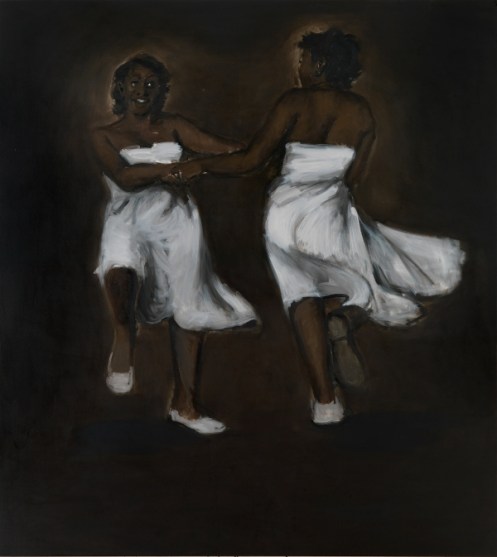
The artist’s Shoot the Desperate, Hug the Needy, from 2010.
CARRIE RODRIGUEZ, THE STATE ROOM, Tuesday, Feb. 19, 8 p.m., $12
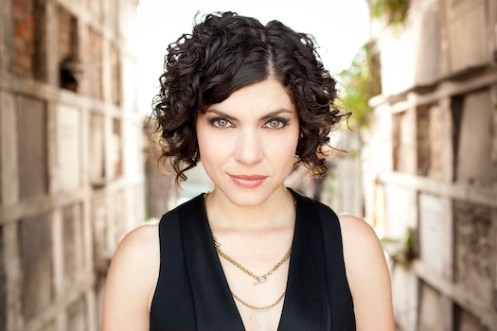
I first caught wind of Carrie Rodriguez when she came through Salt Lake City for a show at the old Zephyr Club alongside Chip Taylor, the man who wrote “Wild Thing.” At that time, she was a young fiddle-playing wunderkind who largely let Taylor take center stage. A decade later, Rodriguez has grown into a stellar singer/songwriter in her own right, and she’s just released her fifth full-length album, Give Me All You Got. With a voice that only seems to get better with age, and a keen knack for penning striking lyrics, Rodriguez seems to be hitting her stride as a solo artist, while still finding time to perform here and there with the likes of Lyle Lovett, John Prine, Bill Frisell, Alejandro Escovedo, and Los Lobos. Jeff Crosby opens the show Tuesday. If you bought tickets in advance, some were printed with “Wednesday, Feb. 19” on them–note that the show is actually Tuesday, Feb. 19.

L-R: Celeste Ciulla (Bev), Erika Rose (Francine) and David Manis (Russ). Photo by Alexander Weisman.
Every now and again, a theater performance comes along that reveals a strength of vision rarely seen, and Pioneer Theatre Company’s new production of Clybourne Park is just such a show.
Playwright Bruce Norris’s 2011 Pulitzer Prize winner for Drama is a cleverly constructed dive into American race relations, a two-act wonder that spans 50 years and combines engaging characters, passionate dialogue and, in the hands of a roundly capable cast, winning performances throughout.
Truly, the success of Pioneer’s production relies on a cast capable of doing double-duty, playing different characters in Act I than in Act II, and Pioneer’s cast comes through on that score. The first half of Clybourne Park is set in 1959, in the home where Bev (Celeste Ciulla) and Russ (David Manis) are packing up and moving on–essentially running away from the darkness left by their son Kenneth’s demise after returning home from the Korean War.
Tying his script to the American classic A Raisin in the Sun, Norris’s Russ and Bev are selling their home in their white neighborhood to the black Younger family from Lorraine Hansberry’s 1959 work, resulting in a panicked uproar from neighborhood busybodies Karl (Brian Normoyle), his wife Betsy (Tarah Flanagan) and local pastor Jim (Kasey Mahaffy).
Humor-laced debates on cultural differences in cuisine and hobbies easily interact with Russ’s tortured father, still mourning his son’s loss and seemingly exhausted by his community and ready to get out. Bev’s harried wife tries to keep the peace, not very successfully, and the presence of the family’s black maid Francine (Erika Rose) and her husband Albert (Howard W. Overshown) leads to some increasingly uncomfortable, but mesmerizing, exchanges.
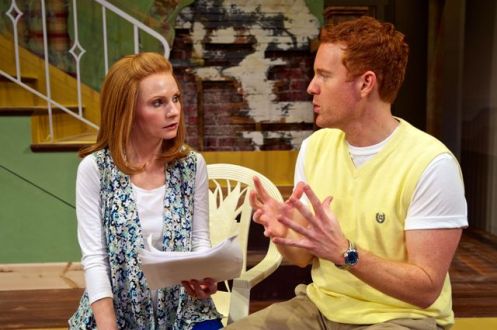
L-R: Tarah Flanagan (Lindsey) and Kasey Mahaffy (Tom). Photo by Alexander Weisman.
The second act fast-forwards 50 years to 2009, when the same house is now in a predominantly black neighborhood undergoing gentrification, with a white couple (played by Flanagan and Normoyle) trying to buy the place in order to tear it down and build a new house. Norris’s dialogue is even more biting in this contemporary setting, the humor heightened by the stark relief compared to the tense exchanges that build throughout the scenes.
There are no weak links among the cast, who collectively handle Norris’s rapid-fire exchanges gracefully and with the required passion. The play moves along quickly, and strikes a fine balance between its serious messages and well-deserved laughs. It’s far from a simple night at the theater, but it’s certainly as entertaining as it is enlightening.
Clybourne Park runs at the Simmons Pioneer Memorial Theatre Mondays through Saturdays until March 2. Tickets range from $25-$44 and are available at the theater’s Website.
BIERSTADT TO WARHOL: AMERICAN INDIANS IN THE WEST, UTAH MUSEUM OF FINE ARTS, Feb. 15-Aug. 11
The new exhibit of Native American imagery opening at the Utah Museum of Fine Arts on Feb. 15 offers what UMFA Executive Director Gretchen Dietrich dubbed “an incredibly diverse group of art objects,” and after a quick preview of the show, I can confirm that the lady ain’t lying.
But it’s not the size of the show that is most striking aspect. It’s the scope of perspectives on American Indian life and art that make this a must-go for art lovers–even those who think they’ve seen plenty of “Western art” in their lifetimes. The Bierstadt to Warhol show offers a look at Native American life through the eyes of American and European artists, but it adds some stunning pieces done by Native American artists themselves. And it throws in playful twists on traditional Indian imagery by more contemporary artists like Andy Warhol and Roy Lichtenstein, among others.

“Tea Party,” by Kevin Red Start of Montana’s Crow Nation. From the Collection of Diane and Sam Stewart
The show, Dietrich said, is ” a history of American dreams and ideas about what it means to be a Native American person.”
Donna Poulton, UMFA’s curator of Art of Utah and the West, added that the show includes more than 100 works spanning more than 160 years. It’s a combination of paintings and sculptures that includes works by some of America’s famed Hudson River Valley artists, who romanticized the West early on, to Paris-trained Taos Society of Artists, who focused on the truth and beauty of nature, to contemporary Native Americans capturing a more realistic look at life among the Indians, and ultimately to the Warhols, et al, who played with “reinterpreting cliches” of Indian imagery.
Much of the show is drawn from the private collection of Sam and Diane Stewart, local art lovers and UMFA board members, who started buying artwork of Native Americans about a dozen years ago.
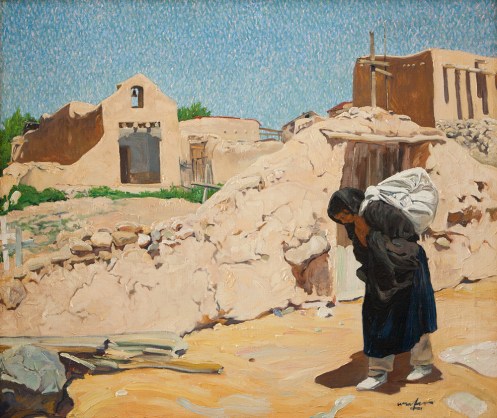
Walter Ufer’s “Washer Woman,” from the Collection of Diane and Sam Stewart.
There was no rhyme or reason to what they bought, Diane said, noting that “we bought with our hearts, and it’s nice to see them approached in this scholarly way” with the UMFA show.
Unwittingly, the Stewarts’ collection has a theme that came through their purchases.
“We were not buying cowboys,” Diane noted. “What spoke to us in the art of the American West were Indians. And women.”
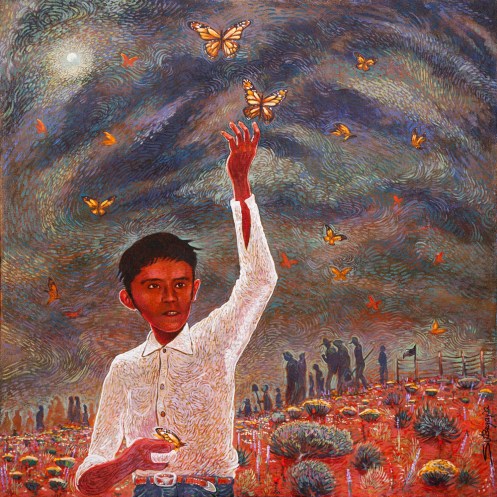
As a result the Bierstadt to Warhol show features plenty of portraits, along with stunning natural landscapes and some incredibly moving work by Native American artists, particularly that of Navajo artist Shonto Begay, who will be doing a free artist talk Friday night at 6 p.m. at the UMFA, followed by a community celebration of the show’s opening.
Here is Begay’s Grandfather’s Funeral:
 Daniel Nailen