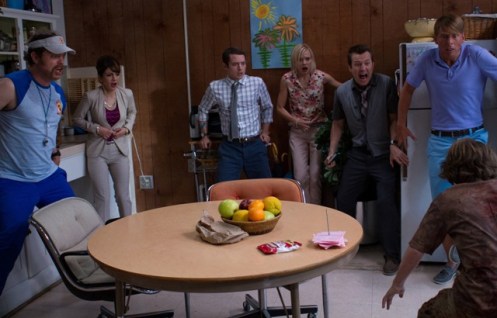
Given the presence of comedy pros like Rainn Wilson (The Office), Jack McBreyer (30 Rock) and Nasim Pedrad (Saturday Night Live), as well as actors with definite comedy chops (Elijah Wood, Alison Pill), it’s no surprise that horror-comedy Cooties delivers on the “comedy” half of that label.
The pleasant surprise with Cooties is how effective the action-packed horror aspect of the movie works. Granted, Cooties is far more of a comedy than a typical splatter flick, and much of the gore and mayhem is here to serve the jokes that come fast and furious throughout the 96-minute running time. Even so, there is real tension and some scary thrills along the way that serve the movie well.
The action starts almost immediately, when wannabe author Clint Hadson (Wood) shows up at his hometown elementary school to serve as a substitute teacher. He meets the other teachers, including old friend Lucy (Pill) and her jock PE teacher boyfriend (Wilson), before heading to class, where one of his students attacks another teeth-first, a virus of some sort having turned the attacking child into a mini-zombie. Soon enough, the virus has spread through all the students save two who hole up with Clint and his new faculty friends and try to hatch a plan to alert and outside world to their plight, and escape in the process.
The brutal and hilarious efforts of the teachers to contend with constantly attacking adolescents makes for a fun flick, particularly with the comedic aces involved throwing lines at each other that nod to horror-movie tropes and their own story’s absurdity. Wood and Pill make for a fine duo dabbling in a forbidden romance to the chagrin of Wilson’s macho man, and Pedrad gets some of the best lines of the film playing a conservative teacher obsessed with keeping gay teachers, like McBreyer’s character, away from the children. Yes, even a zombie horror-comedy has time for some political satire, and the jokes throughout land at a high percentage.
It makes sense for Cooties to be part of the edgy Park City at Midnight portion of Sundance, but I expect you’ll see it in wide release soon enough.
Remaining Cooties showings:
Tuesday, Jan. 21, 2:30 p.m., The MARC, Park City
Friday, Jan. 24, 11:45 p.m., Library Center Theatre, Park City

Marmato is a small town built high in the mountains of Colombia, directly on top of a hill that holds what is estimated to be $20 billion worth of gold, one of the largest remaining gold deposits on the planet. The documentary that takes its name from the town explores the centuries-old mining culture of the townspeople who work in a series of old mines using antiquated techniques, and what happens when a giant Canadian mining corporation comes to town with eyes on that golden prize underneath the natives’ homes.
Shot over the course of six years by Mark Grieco, Marmato traces the effects of the gold boom on the town through several of the townspeople, including a miner, an independent mine owner and a local gold processor and politician worried about the influence of international mining companies. By taking the audience into the family dynamics and history of the town through its people, Grieco effectively sets up a variety of perspectives. While it would be easy to assume the outside influence of a Canadian company is a bad thing for the locals, the benefits and steady work are clearly a boon to some. At the same time, we see other workers who don’t feel they’re getting a fair deal from the big company–same goes for the indie mine owner waiting for a fair price before they sell their mining rights. The company’s plan to displace the entire city and level the mountain to get to the gold, though, brings all the locals together in unified voice to protect their heritage.
Marmato works on several levels–as a treatise on the economics of extraction industries, as a look at a small town culture fighting for survival against the advancement of new technology, as an homage to the old-time mining industry. It manages to keep the audience engaged through the personal stories of the town’s people, and it doesn’t end with any great cause for hope–proving its bona fides as a fine documentary, not just another Hollywood story.
Marmato remaining screenings:
Tuesday, Jan. 21, 6 p.m., Broadway Centre Cinema, SLC
Thursday, Jan. 23, 9 a.m., Egyptian Theatre, Park City
Saturday, Jan. 25, noon, Yarrow Hotel Theatre, Park City

Happiness takes the audience into the high Himalayan kingdom of Bhutan, to the last town in that country to get electricity and all that comes with it–television, the Internet–while telling the story of an eight-year-old Buddhist monk more interested in play, and that new television at his uncle’s house, than studying at the monastery his mother sends him to as the film begins.
Some will quibble that the story of the boy named Peyangki and the effects of the electrification of his village, Laya, doesn’t quality as a “true documentary” given the access enjoyed by director Thomas Balmes and scenes that seem too well-constructed to be true. Ignore those people, and allow yourself to get lost in the stunning photography of Himalayan landscapes and Peyangki’s monastery as the boy shows that the “gross national happiness” the king believes will rise with access to electricity might be totally unnecessary to some of the country’s children. Although Peyangki is as obsessed with the idea of television as any of his fellow villagers, he is shown finding joy in the simplest forms–archery with his friends, turning cartwheels, sprawling in a field of wildflowers and singing to himself. In the meantime, his uncle struggles with traveling three days to sell a yak for money to buy a television–only to drop the TV from his horse on the ride back home, catching hell from his disappointed wife when he tells her the set is broken.
Happiness is far from perfect, and is somewhat predictable in its view that technology doesn’t have the answers for a poor remote village. Peyangki’s sister who left for a big city office career falls into work as a nightclub dancer–a canned cautionary tale in a move that is often truly inspiring. Still, the joy of watching Peyangki mature as a monk while keeping his playful spirit is undeniable, and the film offers a glimpse into a world rarely seen by Westerners. It’s well worth the time spent delving into Peyangki’s world.
Happiness remaining screenings:
Monday, Jan. 20, 3 p.m., Temple Theatre, Park City
Wednesday, Jan. 22, 3 p.m., Egyptian Theatre, Park City
Thursday, Jan. 23, 6:45 p.m., Broadway Cinema, SLC
Friday, Jan. 24, 6 p.m., Holiday Village Cinema, Park City
Saturday, Jan. 25, 9 a.m., Holiday Village Cinema, Park City
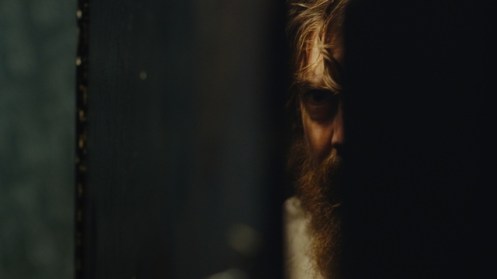
Blue Ruin is a different kind of thriller, a revenge story that forces the audience to come to grips with the fact that the protagonist they’re rooting for to get even with the people who killed his parents might be as responsible for the escalation in violence that happens throughout the film as the decades-0ld crime’s perpetrator. It’s a tense and rewarding ride seeing how director/screenwriter Jeremy Saulnier puts his story together.
The story begins with Dwight living as a vagabond, and we discover he’s still reeling from the murders of his parents when a police officer friend lets him know the murderer is set to be released from jail. Taking the news less than well, Dwight sets off to return to his childhood home and make the man pay for what he did to Dwight’s parents. A somewhat simple revenge plot, though, turns into an exasperating dive into amateurish vigilantism, with Dwight and the family of his parents’ murderer circling each other in increasingly tight circles that the audience can feel.
While the audience naturally sides with Dwight from the get-go, since he’s the first character we meet, his actions aren’t entirely noble. The unintended consequences of his plan drag his sister and her children into the feud, as well as an old friend who has to come to Dwight’s rescue in more ways than one.
The real strength of Blue Ruin is that it jumps right into the action and never lets up, even while being a low-key, relatively simple story told with unfamiliar faces and a low budget. The violence is realistically brutal–as are its effects on Dwight and those around him–and there are moments of dark humor that are all the more funny given the unrelenting tension for much of the film.
Saulnier deserves major kudos for constructing a fine genre piece, and lead actor Macon Blair as Dwight is one to watch.
Blue Ruin remaining screenings:
Sunday, Jan. 19, 11:30 p.m., Prospector Square Theatre, Park City
Saturday, Jan. 25, 9 p.m., Yarrow Hotel Theatre, Park City

A riveting look at the first televised murder trial and a harbinger of reality television madness to come, Captivated: The Trials of Pamela Smart is not only an enthralling dissection of the idea of justice in the modern media age; it’s also an important piece that could conceivably help lead to Smart’s release from prison, ala the West Memphis Three case, if the right people explore some of the evidence presented in the film.
Smart was a New Hampshire high school teacher in the early ’90s whose affair with a student led to the murder of her husband Greg by the student and two of his friends. The three boys eventually pointed the finger at Smart as the instigator of the plot, and she was convicted as an accomplice to the murder and sentenced to life in prison without the possibility of parole–even though the boys who actually shot her husband all cut deals that got them out of life sentences.
Captivated shows how the presence of cameras in the courtroom for the first time ever–and Smart’s own admitted enjoyment of the spotlight–combined to create a media story of a sex-bomb ice queen capable of easily manipulating high school boys to commit murder. The case was a staple for shows like Geraldo, Donahue, Inside Edition and like at the time, as well as a source for TV movies and a fictionalized account inspired by the case that became the Nicole Kidman/Joaquin Phoenix flick To Die For.
Captivated: The Trials of Pamela Smart explores how the media presence around the case changed the way everyone involved behaved, from the accused to the judge, the lawyers to the jury. New interviews with the players, including the imprisoned Smart, and audio tapes secretly recorded by one of the jury members during the trial, combine to make you realize that what everyone thought they knew about this small-town murder might be bogus. Or, at the very least, a media creation barely based in the truth.
Captivated: The Trials of Pamela Smart remaining screenings:
Sunday, Jan. 19, 1:30 p.m., Redstone, Park City
Monday, Jan. 20, 3 p.m., Sundance Resort
Wednesday, Jan. 22, 2:30 p.m., Prospector Square Theatre, Park City
Friday, Jan. 24, 6 p.m., Egyptian Theatre, Park City

Sundance always brings some films to audiences that are confusing, or non-linear, or downright bizarre. After sitting through the Japanese action-comedy R100, I have to say, this move goes right to the top of the list of the most unusual films I’ve ever seen at the festival. What popped in my head watching the story (such as it is) unfold was, “This is like what would happen if John Waters directed a Japanese S&M flick, one with a sci-fi streak.” The set-up is the most normal thing about the movie: a soft-spoken family man with a comatose wife and young son hires a firm that provides S&M activities to sate his hidden sexual appetites. The first twist in R100 is that the company the man hires, simply called Bondage, sends its dominatrices to pleasure/abuse the man at random intervals over the course of a year, and in increasingly public places. These meetings are hilarious for the audience, but eventually go too far, to the point that the man wants to quit the program early–a no-no that he knew about when he signed the contract with Bondage. That sets up a showdown between the man and a slew of the Bondage “queens” that gets increasingly violent, and strange. So strange, in fact, that filmmaker Hitoshi Matsumoto even inserts his own film critics into R100 who pause the action to describe how nonsensical it is. Those asides are some of the funniest moments in the film, offering knowing winks to the audience about the absurdity on screen, even as the action ramps up to an over-the-top finale that would have been great starring Divine.
R100 remaining screenings:
Sunday, Jan. 19, noon, Temple Theatre, Park City
Monday, Jan. 20, 6 p.m., Screening Room, Sundance Resort
Tuesday, Jan. 21, 11:30 p.m., Prospector Square Theatre, Park City
 Daniel Nailen