It will come as no surprise to fans of writer Aaron Sorkin’s work on television like The West Wing, or in movies like The Social Network, that the man’s way with words truly shines in a live theater environment.
Pioneer Theatre Company’s current production of Sorkin’s A Few Good Men flies by in a blaze of witty one-liners, dramatic speeches and courtroom dramatics. Sorkin’s dialogue is delivered by a consistently stellar cast led by Joe Tapper as Lt. J.G. Daniel Kaffee and Kate Middleton as Lt. Comdr. Joanne Galloway–two military lawyers trying to get to the bottom of an apparent murder of a Marine stationed in Cuba by members of his own unit.
Most audience members are probably familiar with the Oscar-nominated 1992 film version of A Few Good Men starring Tom Cruise, Demi Moore and Jack Nicholson, but the live production quickly pushes memories of that to the side thanks to a creative set full of shifting chain-link fences, intricate lighting and fluid direction by Pioneer Artistic Director Karen Azenberg. All told, the stage design was minimalist compared to many of the ornate productions at Pioneer, giving even more emphasis to Sorkin’s words.

(left to right) Spencer Moses (as Lt. J.G. Sam Weinberg), Kate Middleton (as Lt. Cmdr. Joanne Galloway) and Joe Tapper (Kaffee)
Those words are in good hands with the cast. In addition to the appropriately smarmy Tapper and self-serious Middleton’s characters, who bicker their way into finding common ground in the search for justice, several others shine in Pioneer’s production. Torsten Hillhouse’s take on Lt. Col. Nathan Jessep (Nicholson’s role in the film) is an emphatic demonstration of the career military man with a warped sense of priorities. Max Robinson (as Capt. Markinson) and Amos Omer as Lt. Kendrick–two superiors of the accused soldiers–both delivery vivid performances, while Corey Allen and Austin Archer as the accused fighting for freedom are solid as pawns in the game being played by their superiors.

(left to right) Joe Tapper (as Lt. J.G. Daniel Kaffee) and Torsten Hillhouse (as Lt. Col. Nathan Jessep)
A Few Good Men remains a strong theater experience decades after its debut, and seeing it post-9/11 gives some added resonance. It’s well worth seeing for a mid-winter dash of drama.
Pioneer Theatre Company’s A Few Good Men runs through Feb. 8; tickets and showtimes are available at the theater website. Photos courtesy of Pioneer Theatre Company.
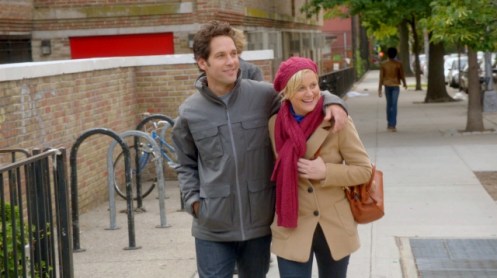
Romantic comedies certainly offer fertile ground for satire, and David Wain–the man behind Wet Hot American Summer, Wanderlust and much of comedy troupes The State and Stella’s best sketches along with co-writer Michael Showalter–would seem a natural for the job.
In They Came Together, Wain and Showalter give rom-coms the Airplane! treatment, packing virtually every second with visual gags and witty wordplay. And he has a cast of undeniably funny folks to deliver the jokes, led by Amy Poehler and Paul Rudd playing Molly and Joel, a star-crossed couple forced to navigate a series of outlandish obstacles to find true love.
Joining Poehler and Rudd are several other vets of Wet Hot American Summer, including Michael Ian Black and Chris Meloni, as well as a slew of comedy heavy hitters, including Ed Helms, Michaela Watkins, Jason Mantzoukas, Bill Hader, Ken Marino and Jack McBreyer. The array of parts large and small given to such talented folks help the film move along.
At its best, They Came Together has moments skewering rom-com cliches like the “meet-cute” and the idea of New York City amplifying the romance that hit their target. There are plenty of scenes along the way that work, and would make for great sketches, but as a whole, it doesn’t really offer a satisfying narrative to hold on to as an audience.
There are too many jokes flying at all times to really care about Molly and Joel’s relationship, and there’s no escaping the sense that Poehler and Rudd are kind of wasting their time here–they’ve both been much funnier elsewhere. Rudd has been in so many of the romantic comedies that They Came Together is mocking that one would expect more nods to his own past work. And while it’s great to see Poehler as a romantic lead in a movie, even a satire, it’s too bad They Came Together doesn’t make better use of her skills.
They Came Together will find an audience of State and Stella diehards, but there’s not enough here to imagine it reaching the mainstream audience who actually goes to the cookie-cutter romantic comedies it’s making fun of–and that’s the audience who might enjoy its satire the most.

Finding a filmmaker and cast capable of juggling aspects of romantic-comedy, straight-up slapstick, and “big-issue” drama is no easy task, making the balance struck in Obvious Child all the more impressive.
In this case, the big issue–abortion–is one certain to make some audience members squirm, but director/co-writer Gillian Robespierre and star Jenny Slate handle the subject so deftly, and so humorously, that Obvious Child‘s take on abortion is refreshingly real.
Slate plays Donna Stern, a Brooklyn standup comic and bookstore employee going through a rough patch after a breakup with a boyfriend who cheated on her and felt she revealed too much of their personal lives in her incisive stage rants. She’s also just found out the bookstore she works at is closing, and her relationship with her mother (Polly Draper) is strained by Donna’s apparently lack of a life plan.
After one drunken, disastrous standup set, Donna has a one-night stand with an all-American business-type, Max (Jake Lacy), leading to a pregnancy that Donna clearly isn’t prepared for. While Max’s pursuit of Donna post-hookup lends a sweet romance to Obvious Child, the meat of the film is Donna’s decision to have an abortion, the relationship with her supportive friends (played, hilariously, by Gaby Hoffman and Gabe Liebman), and the renewed connection with her mother.
Slate offers a remarkable performance as Donna, creating a character that the audience is rooting for immediately, and continues to through the difficulties of emotionally handling her decision, and her blossoming relationship with Max. Written by three women, Obvious Child offers the rare feature-length female perspective from its first frame, and it’s better for it. And the fact it was picked up at Sundance for release by A24 is a good sign that a lot more people will get to see Slate in this star-making turn.
THE AUTUMN DEFENSE, THE URBAN LOUNGE, Friday, Jan. 24, 9 p.m., $14
Talk about your aptly named albums, the new Autumn Defense collection set for release Jan. 28 is called Fifth, and is indeed the group’s fifth set of original tunes. The group is led by two full-time members of Wilco, multi-instrumentalists Patrick Sansone and bassist John Stirratt, who share songwriting duties and are joined by three other long-time members. The sound is less experimental than Wilco, and more in the classic pop-rock vein. Songs on the solid new album float easily along, at times reminiscent of George Harrison’s solo work, and at others recalling long songs you would have found on ’70s-era AM radio. Both Sansone and Stirratt have winning voices, and combining their live set with an opening one from local roots crew The Hollering Pines should make for one fine night out on the town in SLC. The Autumn Defense also plays on Thursday, Jan. 23, at Velour in Provo, along with Desert Noises.


Given the fact Vietnam was the first war televised in almost-real time, one might think there is nothing new to be discovered about the conflict that still haunts American citizens and policy-makers nearly 40 years after the last helicopters took off from Saigon.
Director Rory Kennedy illustrates otherwise with this dive into the last days at the U.S. embassy, showing the moral dilemma Americans faced as they received orders from Washington D.C. to evacuate the country, and leave their allies from the South Vietnamese army and citizenry behind.
Kennedy lets the voices of her interview subjects tell the story of the frantic final stand in 1975, as the North Vietnamese army swept through the country and surrounded Saigon, and her sources are wide-ranging. Kennedy talks to plenty of people who were on the ground at the scene, from CIA agents and U.S. soldiers stationed at the embassy to South Vietnamese soldiers trying to get their families out of the country and Vietnamese citizens ultimately left behind at the embassy grounds. Also on hand for interviews–Henry Kissinger and other D.C. power players still trying to explain away their mistakes from decades ago.
Drawing on remarkable footage of the scene on the ground, Kennedy tells the story of an obstinate ambassador in charge who refuses to consider the U.S. forces would need an evacuation plan, as well as the underlings with a better grasp on reality who went about setting up a secret evacuation for both U.S. forces and South Vietnamese assets they’d worked with on the ground for years.
Finding positives in America’s experience in Vietnam is a rare thing, but seeing Americans risk their own lives for the sake of thousands of Vietnamese allies rather than simply taking care of the Americans–and seeing the pain caused by the fact they couldn’t save all the people who descended on the embassy in these final days–shows that there were some honorable men representing the U.S. in the country, right to the bitter end.
Upcoming screenings:
Saturday, Jan. 25, 6 p.m., Yarrow Hotel Theatre, Park City
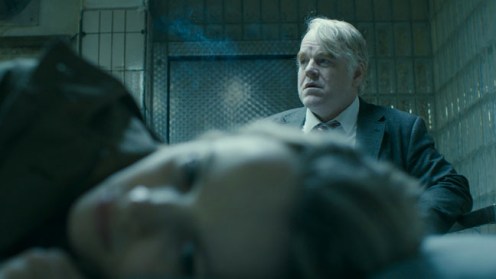
While A Most Wanted Man might be an adaptation of a John le Carre novel, the themes that resonate throughout the spy thriller don’t require any special relationship with the author’s work to connect with film-goers.
The spy thriller set in Hamburg, Germany–where the 9/11 plot was planned and set into motion–tackles a number of issues that have taken on even more resonance since le Carre’s novel was first published in 2008. At the forefront of this story is the competitive and collaborative security relationships between nations in the post-9/11 world.
The lead German spy featured in A Most Wanted Man is Gunter Bachmann, played by Philip Seymour Hoffman, and he struggles to wheel and deal with the U.S. CIA rep (Robin Wright) after having been burned by the American agency in the past. The reliance of intelligence-gathering agencies on high-tech gadgetry is another focus, as are the complicated relationships of countries and governments that we rarely get a glimpse of as average citizens.
Hoffman leads a stellar cast directed by Anton Corbijn, a visionary music video director who has successfully moved into feature films without missing a beat. A Most Wanted Man is not an action movie–anyone looking for car chases or fight sequences will be disappointed. But fans of taut think-pieces packed with geo-political intrigue will find plenty to like as a social worker/lawyer named Annabel Richter, (Rachel McAdams) helps a suspected terrorist elude the authorities, while those authorities, led by Hoffman, follow the accused man’s money through a global terrorism network.
The tense scenes of wiretaps and undercover surveillance are certainly timely in the NSA age, and Hoffman, McAdams and castmates Willem Dafoe and Grigoriy Dobrygin are roundly excellent in this talk-heavy spy game. There’s not exactly a hopeful message at film’s end, in terms of the state of global security, but the ride to get there is worthwhile thanks to the performances of those involved.
Remaining A Most Wanted Man screenings:
Thursday, Jan. 23, 6:30 p.m., Rose Wagner Performing Arts Center, SLC
Friday, Jan. 24, 9:30 p.m., Peery’s Egyptian Theatre, Ogden
Saturday, Jan. 25, 6:30 p.m., Redstone Cinema, Park City
 Daniel Nailen